Insights
AI Image Generation API Pricing: Per-Image Costs Compared
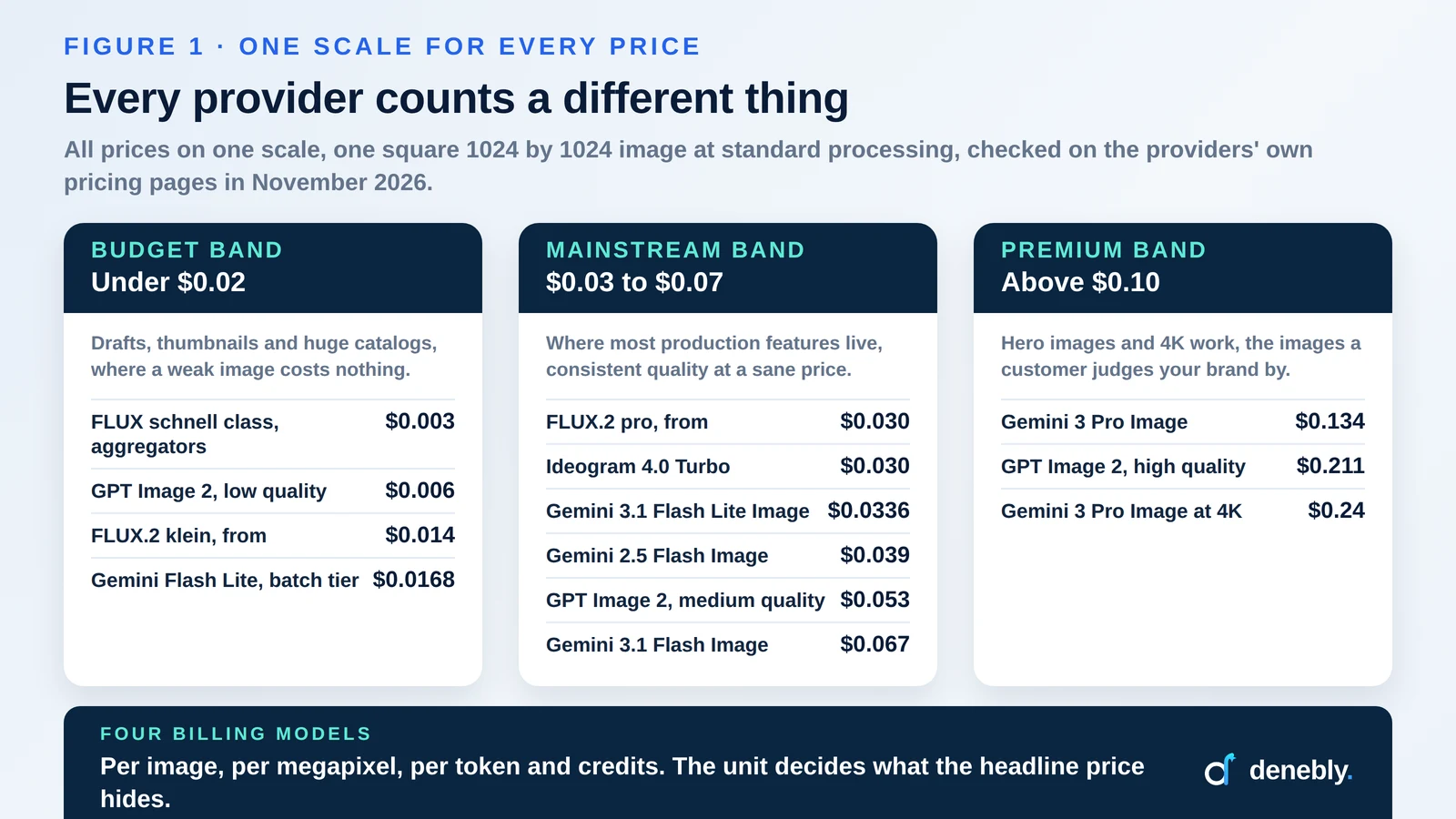
Every pricing page in this market says its images cost pennies, and they are all telling the truth. The numbers still do not compare, because each provider counts a different thing: one charges per image, one per megapixel, one per token, one in credits. This guide puts ai image generation api pricing on one scale: one square 1024 by 1024 image, standard processing, checked on the providers’ own pricing pages in November 2026.
At 1024 by 1024, ai image generation api pricing runs from about $0.003 per image for FLUX schnell class models on aggregator platforms to $0.24 for Google’s Gemini 3 Pro Image at 4K. The mainstream middle sits between $0.03 and $0.07: Gemini 3.1 Flash Lite costs $0.0336, Gemini 2.5 Flash Image $0.039, GPT Image 2 at medium quality $0.053, and Gemini 3.1 Flash Image $0.067. The same provider can span a 35x range: GPT Image 2 costs $0.006 at low quality and $0.211 at high.
Key takeaways:
- Four billing models hide behind the headline prices: per image, per megapixel, per token, and credits
- At 1,000 images a month, real bills run from about $6 to $211 depending on model and quality
- Batch modes are the biggest honest discount: Google’s batch tier halves image prices
- Headline prices assume every generation is a keeper; at 3 tries per usable image, your real cost triples
- Two flagship models were shut down in the last three months, so the cheapest API is not always the cheapest choice
Budgeting an image feature or a content tool? We can model the real monthly cost across providers before you commit. Let’s Discuss Your Project and we will run the numbers with your volumes.
Why Per-Image Prices Are Hard to Compare
The first problem with ai image generation api pricing is that the unit changes from provider to provider. Before the numbers mean anything, you have to know what each provider is actually selling.
| Billing model | Who uses it | What it hides |
|---|---|---|
| Flat per image | Ideogram, Gemini 2.5 Flash Image | Simple, but quality tiers still multiply the price |
| Per megapixel | Black Forest Labs FLUX.2, fal | A 4K image costs about 16x the 1K price |
| Per token | OpenAI GPT Image, Gemini 3.1 Flash Image | The per-image cost only appears after a calculator |
| Credits | FLUX.1 on BFL, Stability AI | The credit-to-dollar rate decides everything |
Quality tiers are the second trap. A provider advertising images “from half a cent” is quoting its lowest quality setting, which most products cannot ship. OpenAI’s own table makes the spread plain: the same model, the same size, and the price moves from $0.006 to $0.211 just by changing quality from low to high. Any comparison that does not fix the size and the quality tier is marketing, not math.
The Comparison: Per-Image Costs at 1024 by 1024
Here is ai image generation api pricing on one scale. Every figure is the image output cost for one 1024 by 1024 image at standard processing, from the provider’s official pricing or calculator. Input tokens for prompts and edits are extra everywhere and covered below.
| Model | Billing | Per image | Per 1,000 images |
|---|---|---|---|
| FLUX.1 schnell class (via aggregators) | Per megapixel | about $0.003 | about $3 |
| GPT Image 2, low quality | Per token | $0.006 | $6 |
| FLUX.2 klein 4B | Per megapixel, from | $0.014 | $14 |
| Gemini 3.1 Flash Lite Image, batch | Per token | $0.0168 | $16.80 |
| FLUX.2 pro | Per megapixel, from | $0.030 | $30 |
| Ideogram 4.0 Turbo | Per image | $0.030 | $30 |
| Gemini 3.1 Flash Lite Image | Per token | $0.0336 | $33.60 |
| Gemini 2.5 Flash Image | Per token | $0.039 | $39 |
| GPT Image 2, medium quality | Per token | $0.053 | $53 |
| Ideogram 4.0 Default | Per image | $0.060 | $60 |
| Gemini 3.1 Flash Image | Per token | $0.067 | $67 |
| Gemini 3 Pro Image | Per token | $0.134 | $134 |
| GPT Image 2, high quality | Per token | $0.211 | $211 |
Read the table as bands, not a league table. The budget band under $0.02 is for drafts, thumbnails, and huge catalogs where a weak image costs nothing. The $0.03 to $0.07 band is where most production features live. Above $0.10, you are paying for the hardest jobs: images a customer will judge your brand by.
OpenAI: GPT Image Pricing
OpenAI bills in tokens, so its ai image generation api pricing needs one conversion. Image output costs $30 per million tokens on the current GPT Image 2.5 models, and OpenAI’s own calculator table for GPT Image 2 gives the working numbers: at 1024 by 1024, low quality is $0.006 per image, medium is $0.053, and high is $0.211. The 2.5 models price the same way, with calculator estimates starting at $0.00588 for a basic generation.
Three details matter for budgets. First, edits cost more than fresh generations, because input images are billed too and processed at high fidelity by default. Second, streaming partial images during generation adds tokens per preview. Third, the low tier is genuinely useful: for drafts, mood boards, and internal mockups, $0.006 an image is close to free, and the sensible workflow is to draft cheap and render only the winners at medium or high. Teams building on OpenAI should also note the churn: gpt-image-1 was shut down on October 23, 2026, a reminder to pin model versions and watch deprecation notices.

Google: Gemini Image Pricing
Google’s lineup is the clearest example of how ai image generation api pricing splits by speed tier, and Google publishes the per-image equivalents itself:
- Gemini 3.1 Flash Lite Image: $0.0336 per 1K image (1,120 tokens at $30 per million). The batch tier halves it to $0.0168.
- Gemini 2.5 Flash Image: $0.039 per image, or $0.0195 on batch. Note that Google has set this model to shut down on March 15, 2027 and points users to the 3.1 Flash Lite.
- Gemini 3.1 Flash Image: $0.067 at 1K, then resolution steps bite: $0.101 at 2K and $0.151 at 4K, because output is billed at $60 per million tokens.
- Gemini 3 Pro Image: $0.134 per image in the 1K to 2K class and $0.24 at 4K, the premium end of the mainstream market.
The batch pattern is the story here. If your images do not need to appear instantly (catalog backfills, blog visuals, variants), Google’s batch pricing is the largest straightforward discount in this comparison: the same model at half price. Google also carries the market’s freshest deprecation scar: Imagen 4, its previous flagship image model, shut down on August 17, 2026.
FLUX, Ideogram, and the Aggregator Route
Black Forest Labs prices FLUX.2 by the megapixel, which makes small images very cheap and large ones proportionally dear. FLUX.2 klein starts from $0.014 for the first megapixel and FLUX.2 pro from $0.030, so a standard square image lands at those figures, while a 4K render costs roughly sixteen times more. The older FLUX.1 line bills in credits at $0.01 per credit on BFL’s own API.
Ideogram is the specialist. Its API charges a flat per-image rate, $0.03 for Turbo, $0.06 for Default, and $0.10 for Quality, and its strength is text inside images: posters, labels, and ads where the words must come out spelled right. Most general models still fumble lettering, so for text-heavy work the flat rate buys fewer wasted retries.
The aggregator route, through platforms like fal, Replicate, and Together, hosts open models under one key. FLUX schnell class generation runs about $0.003 per image there, the floor of this comparison. The trade is operational: one more vendor between you and the model, and quality that suits drafts and volume work better than hero images. Denebly usually prototypes image features for client products here: a $3 thousand-image test answers the quality question before real money moves.
What Volume Actually Costs
Ai image generation api pricing feels abstract until it meets a real workload. A store generating 10,000 product images a month pays about $30 on FLUX schnell class hosting, $140 on FLUX.2 klein, $336 on Gemini Flash Lite or $168 on its batch tier, $530 on GPT Image 2 medium, and $2,110 at GPT Image 2 high quality. The model choice is the budget; nothing else comes close.
Then apply the retry multiplier, the number no pricing page prints. Product teams rarely keep the first generation. At an average of three generations per usable image, which is normal for brand-sensitive work, every figure above triples: the $530 plan is really $1,590. Prompt templates, fixed seeds for product lines, and a cheap draft tier for exploration are how you pull that multiplier back toward 1. If you want, Let’s Discuss Your Project and we will pressure-test your volume assumptions before you pick a provider.

Hidden Costs and Traps
Four costs sit outside the headline rate:
- Edit inputs. Editing or restyling an existing image bills the input image as well as the output, and high-fidelity input processing raises it further. Editing-heavy products can pay 30 to 50 percent more than generation-only math suggests.
- Failed and refused generations. Retries after errors, safety refusals on edgy prompts, and test traffic during development all add quiet volume.
- Everything around the API. Storage, CDN delivery, moderation checks, and the engineering time to swap models when one is deprecated. Two flagship models shut down in the last three months; migration time is a real line item.
- Subscription comparisons. Consumer plans from $10 to $120 a month look simple, but they carry usage caps, no API access, and terms that may not cover your product’s use.
From our side of the table, the deprecations are the trap teams feel most. A pipeline built on a model that shuts down does not just need a new endpoint; prompts tuned for one model rarely transfer cleanly, so you pay in testing time what you saved in per-image discounts.
How to Choose
With ai image generation api pricing, match the tier to the job. Drafts, variants, and internal visuals belong on the cheapest models you can tolerate, including the $0.003 to $0.017 band. Customer-facing images belong in the $0.03 to $0.07 mainstream, where quality is consistent and text rendering is survivable. Reserve the $0.13-plus premium tier for hero images and 4K work. Use batch mode for anything that can wait, pin your model version, and re-check prices quarterly, because this market reprices constantly. If you want the shortlist behind these tiers, see the best AI image generation API picks, ranked by the job they fit best.
If image generation is one piece of a bigger build, our generative AI services cover the model selection, the pipeline, and the cost controls together. Let’s Discuss Your Project is where that conversation starts.
FAQ
What is the cheapest ai image generation api pricing per image?
FLUX schnell class models hosted on aggregator platforms, at about $0.003 per 1024-class image. Inside the big providers’ own APIs, the cheapest entries are GPT Image 2 at low quality ($0.006) and Google’s Gemini 3.1 Flash Lite on batch ($0.0168).
How much does it cost to generate 1,000 images?
At 1024 by 1024, between about $3 and $211 depending on the model and quality tier. Mainstream production choices cluster at $30 to $67 per thousand: FLUX.2 pro $30, Gemini Flash Lite $33.60, GPT Image 2 medium $53, Gemini 3.1 Flash Image $67.
Why does the same model have such different prices?
Quality and resolution settings change the work the model does. OpenAI’s GPT Image 2 moves from $0.006 at low quality to $0.211 at high quality at the same size, a 35x spread, because higher quality generates far more output tokens.
What is the difference between per-image, per-megapixel, and per-token billing?
Per-image billing charges a flat rate per output (Ideogram). Per-megapixel billing scales with output size (FLUX.2), so a 4K image costs about 16x a 1K one. Per-token billing charges for the image tokens a generation produces (OpenAI, Google), which is why those providers quote per-image costs through calculators.
Does batch generation really cut image API costs?
Yes. Google’s batch tier halves image prices on its Gemini image models: Gemini 3.1 Flash Lite drops from $0.0336 to $0.0168 per image, and Gemini 2.5 Flash Image from $0.039 to $0.0195. The trade is speed: batch jobs are for work that does not need instant results.
Are edits more expensive than new generations?
Usually yes. An edit bills the input image tokens on top of the output, and current models process inputs at high fidelity by default. Budget editing-heavy workflows 30 to 50 percent above generation-only estimates.
How often do image API prices change?
Constantly. Models are repriced, replaced, and shut down: Imagen 4 shut down in August 2026 and gpt-image-1 in October 2026. Check the provider’s pricing page before committing a budget, and re-check quarterly.
Which API is best for images with text in them?
Ideogram built its name on text rendering and charges a flat $0.03 to $0.10 per image by tier. Gemini 3 Pro Image ($0.134) is the premium alternative for complex compositions with lettering. For posters, labels, and ads, either beats re-rolling a general model until the words come out right.
Can I use subscription plans like Midjourney instead of an API?
For a person making images by hand, yes. For a product, no: no proper API access, usage caps, and terms that may not cover commercial embedding. API pricing is the right comparison for anything you ship.
Conclusion
Ai image generation api pricing only looks simple. Underneath, four billing models, quality tiers that swing prices 35x, batch discounts worth half the bill, and a retry multiplier decide what you actually pay. The good news: at every budget from $0.003 to $0.24 an image, there is a model that fits, as long as the tier matches the job. If you want the model choice and the cost model settled before you build, Let’s Discuss Your Project: email sales@denebly.com or call +1 (214) 896-2906 and we will map the pricing to your real volumes.

WRITTEN BY
Arslan Mushtaq
Founder, Denebly
Arslan founded Denebly in 2018 and leads its AI development work for startups and mid-size businesses, across AI chatbots, agentic workflows, RAG systems, machine learning and automation. Denebly has delivered 100+ projects from Dallas, Texas.
Ready to Solve Your Business Problems With AI?
Tell us what you are trying to build, automate or fix. You will get an honest assessment within one business day, not a sales pitch.