Prisma vs Drizzle for TypeScript Teams, Same Schema, Two Different Tools
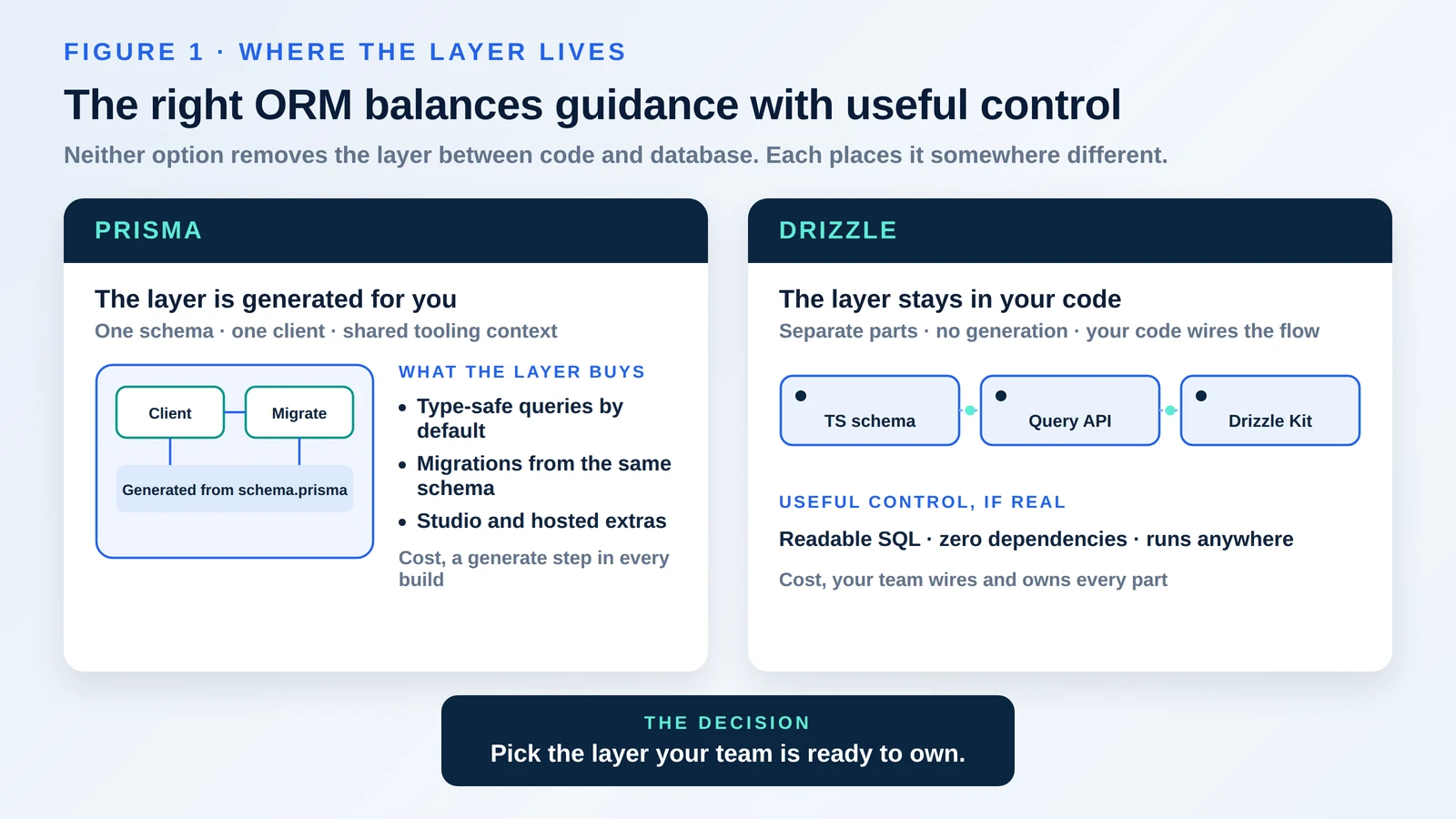
Every TypeScript backend reaches the same fork. The API is planned, the database is Postgres, and the team must pick the layer between the two for the next five years. The shortlist is always the same two names, and the argument runs on slogans. Prisma is easier. Drizzle is faster.
Neither slogan survives the current versions. Prisma 7 removed the Rust engine that made it heavy, and Drizzle has grown a relational API and a corporate backer. This guide compares prisma vs drizzle on the same schema, the same query and the same deploy targets, so the difference is visible, not described.
Key Takeaways
- The real split is where the schema lives. Prisma keeps it in its own language and generates a client. Drizzle keeps it in TypeScript and generates nothing.
- On simple queries, performance is close to a tie. The gaps are bundle weight, cold starts and one pagination trap, and they point in both directions.
- Pick by runtime and team, not by benchmark. Edge and serverless work fits Drizzle better. Guided tooling and MongoDB fit Prisma better.
The data layer is a decision we settle first when a client brings us a backend to build, because changing it later means rewriting every query. See how we approach it on our custom software development page.
The short version
Start from your constraints, not from the feature list. This table is the whole comparison on one screen. The sections after it show how each score was earned.
| Requirement | Start with | Why |
|---|---|---|
| You deploy to edge runtimes or small serverless functions | Drizzle | Zero dependencies, no generated client, direct drivers for serverless databases |
| Your team thinks in SQL and wants to see every query | Drizzle | The API is shaped like SQL, each call maps to one statement you can read |
| Your team wants guardrails and a guided workflow | Prisma | One schema file, a generated client, and migrations that hold your hand |
| You need MongoDB alongside relational data | Prisma | Drizzle is relational only, Prisma supports MongoDB in the same client |
| You want a managed database bundled with the ORM | Prisma | Prisma Postgres is one command away, Drizzle leaves the database to you |
We ran the same exercise in our guide to InfluxDB vs TimescaleDB for IoT, and the pattern repeats. The tool that wins is the one whose assumptions match your workload.
What Prisma is
Prisma ORM is the older and larger project, and it has three parts, per its own documentation. Prisma Client is an auto-generated, type-safe query builder. Prisma Migrate turns schema edits into SQL migrations. Prisma Studio is a GUI for viewing and editing data. Around those sit the paid products, Prisma Postgres, a serverless Postgres, and Accelerate, a pooling and caching layer.
The defining choice is the schema. You describe your models in Prisma’s own schema language, in a schema.prisma file, and run prisma generate to produce the client your code imports. Change a model and you generate again. Supporters call it a single source of truth in a purpose-built language. Critics call it a second language to learn and a build step to forget at the worst moment. Both are describing the same fact.
Prisma 7, the current stable line, changed the machinery underneath. The Rust query engine is gone, replaced by a TypeScript client with a WebAssembly query compiler. Prisma claims a 90 percent smaller bundle output and 3x faster query execution for the release, and those are vendor numbers, but the direction is not in dispute. The client now lands in your source tree instead of node_modules, settings moved into a prisma.config.ts file, and you install a driver adapter per database.
What Drizzle is
Drizzle ORM calls itself a headless TypeScript ORM. There is no schema file in a separate language and nothing to generate. You define tables in TypeScript, with pgTable for Postgres, and query types are inferred from those definitions on the spot. Its documentation leads with a promise, if you know SQL, you know Drizzle, and with a fact, the library has zero runtime dependencies.
It ships two query APIs. The SQL-like builder reads as the statement it sends, select, from, where, joins spelled out. The relational API, db.query, fetches nested data with a with clause and, per the docs, always outputs exactly one SQL query per call. Drizzle Kit is the companion CLI. It generates SQL migration files from your schema, applies them, pushes schema changes straight to a database, and pulls a database into a TypeScript schema.
The project changed hands in 2026. In March, PlanetScale announced the Drizzle team was joining the company, with Drizzle staying independent on its own roadmap. That answers the sustainability question that used to hang over Drizzle, and raises one about where a database vendor will steer it.
The same schema in both tools
Here is one task done both ways, labelled illustrative because the schema is a composite SaaS shape, three tables, users, workspaces and a membership join between them. Adding a table is the job you will repeat most, so watch the steps, not the syntax. First, Prisma.
model User {
  id          Int          @id @default(autoincrement())
  email       String       @unique
  name        String?
  memberships Membership[]
}

model Workspace {
  id          Int          @id @default(autoincrement())
  name        String
  createdAt   DateTime     @default(now())
  memberships Membership[]
}

model Membership {
  userId      Int
  workspaceId Int
  role        String
  user        User      @relation(fields: [userId], references: [id])
  workspace   Workspace @relation(fields: [workspaceId], references: [id])
  @@id([userId, workspaceId])
}
Two commands ship it. prisma migrate dev works out the SQL and applies it, then prisma generate rebuilds the client to match. The same schema in Drizzle.
export const users = pgTable("users", {
  id: serial("id").primaryKey(),
  email: varchar("email", { length: 256 }).notNull().unique(),
  name: varchar("name", { length: 256 }),
});

export const workspaces = pgTable("workspaces", {
  id: serial("id").primaryKey(),
  name: varchar("name", { length: 256 }).notNull(),
  createdAt: timestamp("created_at").defaultNow().notNull(),
});

export const memberships = pgTable("memberships", {
  userId: integer("user_id").notNull().references(() => users.id),
  workspaceId: integer("workspace_id").notNull().references(() => workspaces.id),
  role: varchar("role", { length: 50 }).notNull(),
}, (t) => [primaryKey({ columns: [t.userId, t.workspaceId] })]);
Here drizzle-kit generate writes the SQL migration file, and drizzle-kit migrate applies it. No client is rebuilt, because there is no client. Count the moving parts. Prisma asks you to learn its modelling language, relations declared as fields that do not exist in the database, and then runs two steps. In return the migration is planned for you and the client always matches the schema. Drizzle keeps everything in the language you already write, and generate writes a SQL file you can read and edit before it runs. The control is real, and so is the responsibility. A hand-edited migration is a feature until it is a 2 a.m. incident.
The same query in both tools
Now the read every dashboard makes, one page of workspaces, members and roles, newest first, twenty at a time. Illustrative, same tables as above. Prisma first.
const page = await prisma.workspace.findMany({
  take: 20,
  orderBy: { createdAt: "desc" },
  include: { memberships: { include: { user: true } } },
});
And the same read through Drizzle’s relational API.
const page = await db.query.workspaces.findMany({
  limit: 20,
  orderBy: desc(workspaces.createdAt),
  with: { memberships: { with: { user: true } } },
});
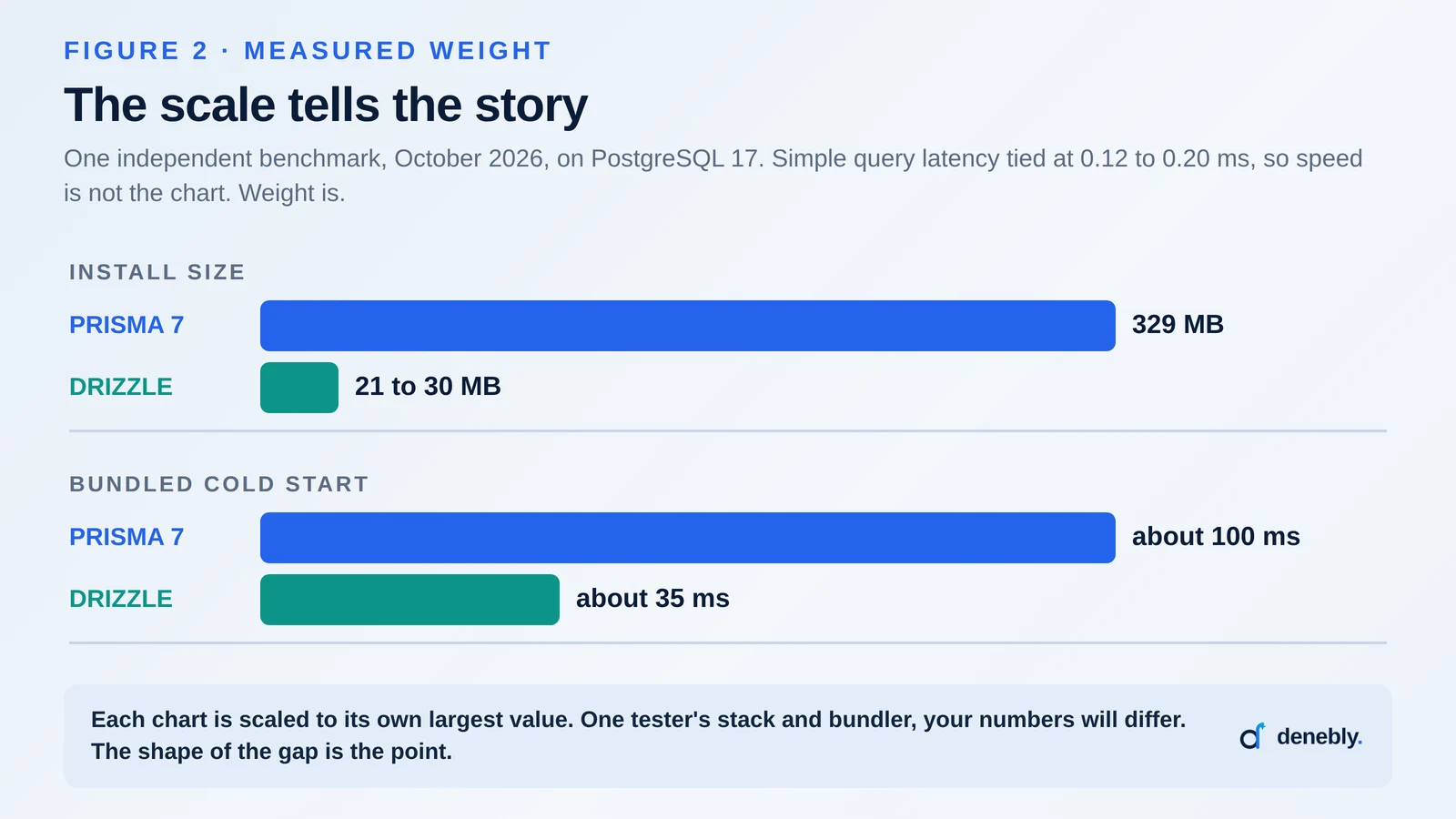
The shapes look similar, and that is the point. The difference is what reaches the database. Prisma splits a nested read into separate queries and stitches the results in the client. Drizzle’s relational API folds the same read into one statement. One published benchmark shows where that trade lands. In Fab Waseem’s October 2026 test on PostgreSQL 17, a deep page of nested results took 4.65 ms through Drizzle’s single query against 0.75 ms through Prisma’s split queries, while simple lookups tied at 0.12 to 0.20 ms for both. One tester’s numbers, but the mechanism is structural. Nested OFFSET pagination punishes the single-query shape. Switch to cursor pagination and most of the gap closes.
Bundle size, cold starts and the edge
This is the axis that built Drizzle’s reputation, and it is narrower than the slogans say. Drizzle is plain TypeScript with zero dependencies, so a bundled function carries almost nothing. Prisma 7 carries its query compiler as WebAssembly, far lighter than the old Rust binary, and Prisma’s 90 percent smaller figure is measured against that old engine, not against Drizzle.
The same independent benchmark measured the practical gap. Cold start, import plus first query, came out at about 35 ms for Drizzle and about 100 ms for Prisma 7. Install weight was 21 to 30 MB against 329 MB, a node_modules figure that matters for images and CI, not the wire. On a long-lived server none of this decides anything. On a function that cold-starts under traffic, or an edge runtime with hard size limits, it still does, and it still points to Drizzle.
One more edge fact cuts the other way. Prisma’s old answer for connection-starved serverless databases was Accelerate, its pooling proxy. Its cache retires on 1 December 2026, and Prisma Postgres now builds pooling into the database.
Migrations and day-two tooling
Migrations are where the philosophies stop being abstract. Prisma Migrate is declarative. You edit the schema, run migrate dev, and Prisma works out the SQL, applies it and regenerates the client. Guardrails are the product. The cost is trust. When the generated migration surprises you, and on a renamed column treated as a drop and an add, it will, you accept it or hand-write SQL outside the workflow.
Drizzle Kit is imperative. Generate writes numbered SQL files and a snapshot, and those files are yours. Teams that review migrations line by line in pull requests prefer this. Teams without a migration habit discover that push, the sync-straight-to-database command, is wonderful in week one and a liability when two developers push different shapes to one shared database.
Day two is closer than the feature lists suggest. Both ship a studio GUI. Both introspect an existing database, prisma db pull and drizzle-kit pull, so switching later is painful but not a rewrite of your data. Prisma’s documentation and ecosystem is bigger, years of community answers against Drizzle’s younger and thinner docs.
Most products we build for SaaS startups live or die on these day-two questions. We prototype the data layer first.
Where each one loses
Prisma loses when the query is the product. Reporting shapes, window functions, partial indexes, JSONB operators, the PostgreSQL features data-heavy products depend on, sit awkwardly behind the model API, and the escape hatch, raw SQL through $queryRaw, gives back the SQL and takes away the type safety that justified Prisma. It also loses on ceremony. Generate steps in CI, a client rebuilt on every schema change, a config file to learn. And its best extras are a funnel. Prisma Postgres is genuinely pleasant, and it is also a paid platform your ORM keeps recommending.
Drizzle loses when the team does not already think in SQL. Your juniors meet joins, grouping and subqueries on day one, with thinner docs and fewer answers to copy. It loses on breadth. There is no MongoDB support at all, where Prisma covers it. And it loses on finish. The migration tooling is younger, the relational API carries the pagination trap shown above, and November 2026 comparisons still list Drizzle 1.0 as a release candidate while Prisma 7 is the stable default. None of these is fatal. All of them are priced in too rarely.
Pick by the project you are actually building
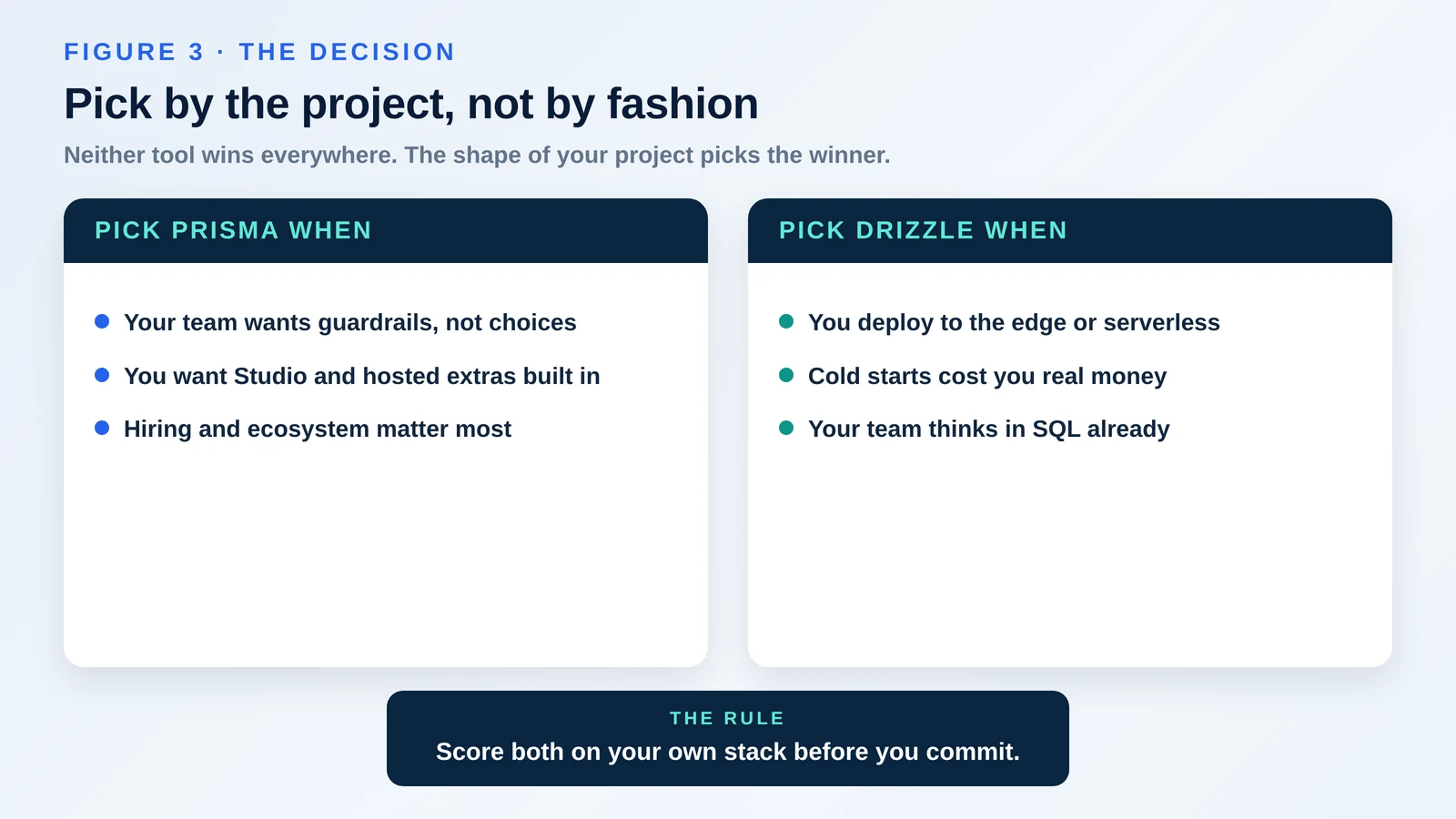
Find your row, then run the scorecard below before you commit. Your schema will vote differently from this table.
| Your project | Start with | Why |
|---|---|---|
| Edge or serverless API on Workers, Deno or small functions | Drizzle | Zero dependencies and serverless drivers keep cold starts and bundles safe |
| SaaS product on a long-lived Node server | Prisma | Guardrails, mature migrations and the bigger ecosystem pay off weekly |
| Team strong in SQL, reporting-heavy product | Drizzle | The query you write is the query that runs, including database-specific parts |
| Team new to backends, first production database | Prisma | The schema language and generated client remove whole classes of early mistakes |
| MongoDB in the stack, or planned | Prisma | Drizzle is relational only, and a second ORM costs more than a compromise |
| Existing database you cannot redesign | Test both | Introspect with db pull and kit pull, then score the generated result, not the promise |
If the data layer is one decision in a larger build, our AI product development work starts with these foundation choices. The interface is the cheap part to change.
Score both on your own stack
Give each tool one afternoon and the same three tasks, your real schema sketched, the nastiest query your product needs, and a deploy to your real target. Score each line 0, 1 or 2. A zero on the deploy target or the must-have query ends the trial, whatever the total says.
| Test | What earns a 2 |
|---|---|
| Your schema | Your three ugliest tables model cleanly, without a workaround |
| Your worst query | Your most complex production query runs in one readable expression |
| Migration drill | Add a column, rename one, deploy both, and the steps feel safe to repeat |
| Cold start | First request on your real deploy target lands inside your latency budget |
| Type behaviour | A deliberate typo in a field name fails at compile time, not in production |
| Raw SQL exit | Dropping to hand-written SQL for one query does not fight the tool |
| Exit cost | Pointing the other tool at the same database and introspecting takes under an hour |
Mistakes that quietly cost teams
- Judging Prisma by its old engine. Most anti-Prisma benchmarks test version 5 or 6, Rust binary included. Prisma 7 removed it. Benchmark the version you will ship.
- Reading bundle size as query speed. Install weight and cold starts are real, and they are not what users feel on a warm server. Measure the axis you actually have.
- Letting OFFSET pagination ship. The single-query nested read that makes Drizzle feel magical slows as pages deepen. Cursor pagination is a design decision, not an optimization.
- Skipping the generate step in CI. A client built from last week’s schema fails in ways that look like database bugs. Generate in the pipeline, every time.
The rule to keep
Decide where the schema lives, test both tools on your worst query and your real deploy target, and let those two afternoons overrule every benchmark, including the ones here. The ORM you understand at 2 a.m. is the right one.
If you would rather have the backend built with these decisions already made, let’s discuss your project. Write to sales@denebly.com or call +1 (214) 896-2906.
Questions developers ask
Is Drizzle faster than Prisma?
On simple queries, no, not measurably. The October 2026 independent benchmark put primary-key lookups at 0.12 to 0.20 ms for both. Drizzle pulls ahead on cold starts and install weight. Prisma pulled ahead on deep nested pagination, its split queries dodge the single-query OFFSET trap. Speed is a property of the query shape, not the logo.
Can Prisma 7 run on the edge and in serverless functions?
Yes. This is the biggest change in the comparison. Removing the Rust engine made the client TypeScript with a WebAssembly compiler, so it runs on Vercel Edge and Cloudflare Workers, and Prisma claims a 90 percent smaller bundle. You install a driver adapter, and Prisma steers pooling to Prisma Postgres or a serverless driver.
Does Drizzle support MongoDB?
No. Drizzle is relational only, PostgreSQL, MySQL, SQLite, SingleStore, SQL Server and CockroachDB, per its documentation. Prisma supports MongoDB in the same client. If MongoDB is in your stack today or on the roadmap, that single fact can end the comparison.
Which ORM has better type safety?
Both are fully type-safe, by opposite mechanisms. Prisma generates types from your schema when you run prisma generate, and Prisma’s work claims 70 percent faster type checks in version 7. Drizzle infers types from your TypeScript schema with no generation step, so types can never drift. Generated types are only as current as your last generate. Inferred types are current by construction.
How hard is it to switch from one to the other later?
The database does not move, only the code does. Both tools introspect an existing schema, prisma db pull and drizzle-kit pull, so the new tool starts from your real tables. The queries are the rewrite, every one of them, plus the migration history. On a young codebase that is days, on a mature one a project. That is why the choice deserves two afternoons now.
Which should a small team pick for a new SaaS product?
The one that matches your runtime and your team’s SQL fluency. Serverless or edge deployment, or a team that reads SQL comfortably, points to Drizzle. A long-lived server, guardrails, or any MongoDB in the picture points to Prisma. If both fit, pick Prisma for the ecosystem, Drizzle for the control, and do not relitigate it monthly.
Sources
- Prisma documentation, What is Prisma ORM, read 15 November 2026.
- Prisma blog, Prisma 7 Release, read 15 November 2026. Rust removal and the bundle and speed claims.
- Prisma documentation, Databases, read 15 November 2026. Prisma ORM v7 database support.
- Prisma pricing page, read 15 November 2026. Prisma Postgres plans and the Accelerate retirement.
- Drizzle documentation, Why Drizzle, read 15 November 2026. Zero dependencies and the two query APIs.
- Drizzle documentation, Drizzle Kit overview, read 15 November 2026.
- PlanetScale blog, Drizzle joins PlanetScale, 3 March 2026.
- GitHub API, read 15 November 2026. Star counts and Apache-2.0 for both repos.
- Fab Waseem, Drizzle vs Prisma in 2026, dev.to, October 2026. The independent benchmark used here.

WRITTEN BY
Arslan Mushtaq
Founder, Denebly
Arslan founded Denebly in 2018 and leads its AI development work for startups and mid-size businesses, across AI chatbots, agentic workflows, RAG systems, machine learning and automation. Denebly has delivered 100+ projects from Dallas, Texas.
Ready to Solve Your Business Problems With AI?
Tell us what you are trying to build, automate or fix. You will get an honest assessment within one business day, not a sales pitch.