AI Generated Ads for Mobile Apps User Acquisition, What They Cost and Whether They Work

A small team ships a budgeting app. They have 5,000 dollars a month for ads and one designer who is already full. They need 30 fresh ad variants a month, because the October winners stopped working in November.
AI generated ads for mobile apps user acquisition are short video and image ads made by AI software that show a mobile app in action and are built to win installs from people who have never heard of the app, so a small team can test dozens of hooks and angles instead of betting the month on one polished video.
If you would rather hand that job to one accountable team, our generative AI team builds ad pipelines this way.
What ads made by AI for app growth are
Ads made by AI for app growth are ads where software writes the script, casts a presenter, renders the footage and cuts the edit. A person still sets the angle, checks the screen recording and reads the results.
The four formats that win installs
Almost every install ad that works is a version of four formats. Pick the format first, then write the hook.
| Format | What happens | Best for | What to watch |
|---|---|---|---|
| Reaction | A person reacts to what the app showed | Finance, health, screen time | Must match a real result |
| Screen record | Presenter sets up the problem, screen sells | Productivity, utilities, SaaS | One tap, one result |
| Problem and solution | One pain named, one tap fixes it | Any app with one hero feature | The pain must feel familiar |
| Testimonial style | A presenter shares real user reports | Habit, learning, wellness | Only real reviews |
EchoUGC, in a guide published 6 November 2026, lists these same four formats and ties each one to the app type it fits. The guide also warns that testimonial style ads need care, because a script must come from real user reviews.
How the ad pipeline works, from brief to live ad
A pipeline is a repeatable path from one line of brief to a live ad. Verts, in a guide read 21 November 2026, sets out five steps, and the steps below follow that shape with a human check added at each end.
- Write one line. Name who the app is for and the one job it does, in one sentence.
- Pull 3 to 5 screens. Take the screens that show the core value, not the settings page.
- Generate the variants. Make 5 to 10 presenter variants per angle, each with a different hook.
- Cut in the real screen. Put your own screen recording in the middle, so the proof is real.
- Export every ratio. Render 9 to 16 for TikTok and Reels, 1 to 1 for feeds, 16 to 9 for YouTube.

What it costs, real tool prices
Prices spread wide, and the difference sits in what a credit buys, not the monthly number. A tool that charges per finished ad is easy to compare.
| Tool | Entry price | What it makes | What to check |
|---|---|---|---|
| EchoUGC | 49 dollars a month, 9 to 12 dollars an ad | AI presenter video ads | Starter covers about 4 videos |
| Creatify | From 15 dollars a month | Video ads from a store link | Credits rarely equal finished ads |
| Pencil | From 14 dollars a month | Image, video and copy ads | Cheapest paid start in the set |
| AdCreative.ai | From 39 dollars a month | Static banners and copy | Best for banners, not video |
| Arcads | About 110 dollars a month | Talking AI actor video ads | Price from third-party checks |
| Verts | 35 dollars | AI video ads and face swaps | Face swaps at 30 credits a second |
| 9x16ads done for you | From 1,600 dollars a month | Finished ads weekly | Apps and games only |
Superapp, in a comparison with prices checked 1 November 2026, lists Creatify at 15 dollars a month, AdCreative.ai at 39 dollars a month, Arcads at about 110 dollars a month and Pencil at 14 dollars a month.
The comparison that decides the budget is AI ad against human creator video. EchoUGC puts a human UGC video at 150 to 212 dollars on Influee, with a median of about 175 dollars, and pro creators on JoinBrands at 500 to 1,200 dollars a video. At those prices, 12 creatives cost about 2,100 dollars from a median human creator and 108 to 144 dollars from AI.
A worked test budget, 5,000 dollars a month
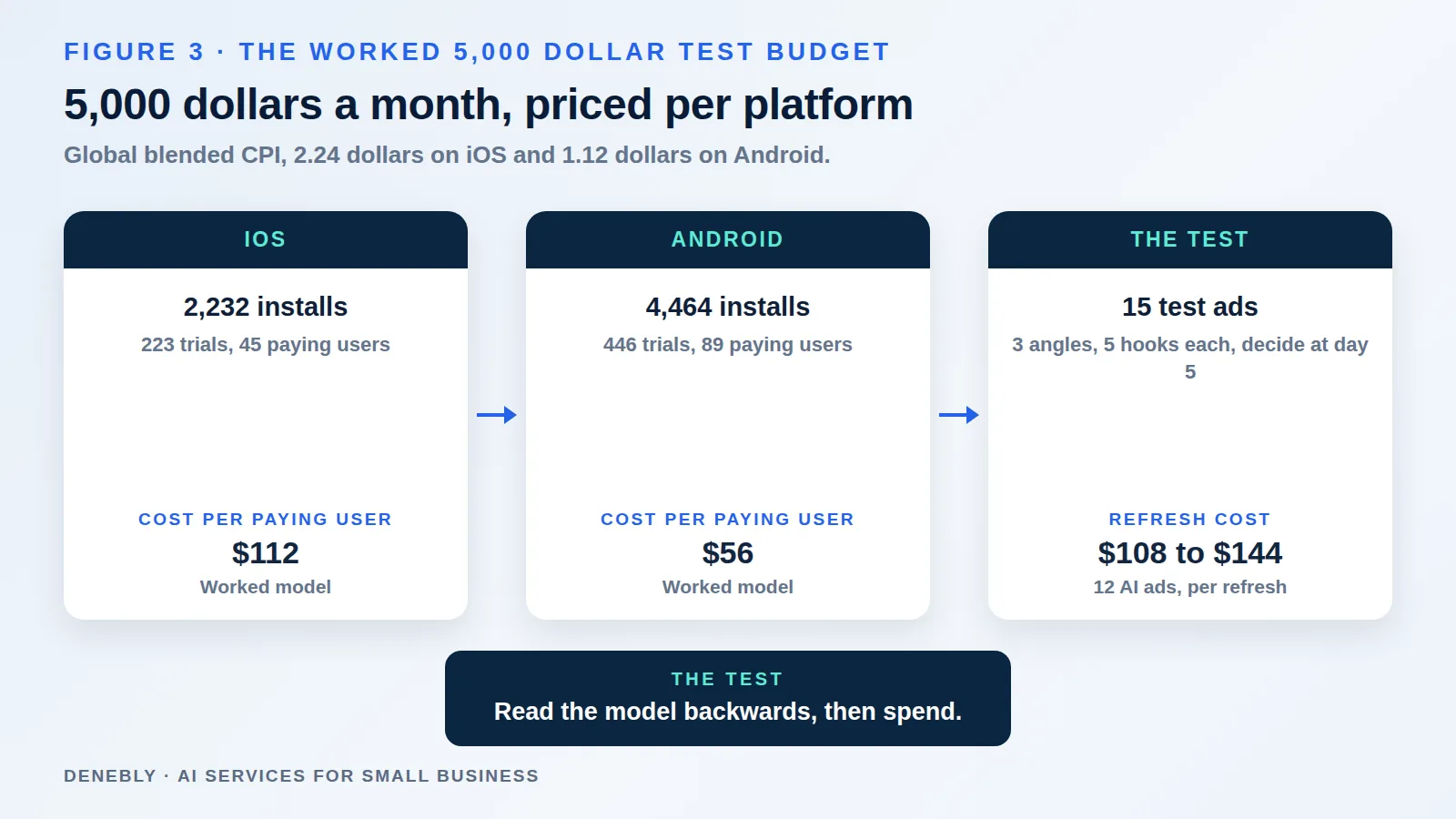
The table below is a worked model with its inputs stated in full, not a forecast. It uses the global blended cost per install of 2.24 dollars on iOS and 1.12 dollars on Android, from a Searchlab 2026 compilation of Adjust and AppsFlyer data, as cited by The Social Outline.
| Step | iOS, 2.24 dollars CPI | Android, 1.12 dollars CPI |
|---|---|---|
| Spend a month | 5,000 dollars | 5,000 dollars |
| Installs bought | About 2,232 | About 4,464 |
| Trials at 10 percent | About 223 | About 446 |
| Paying users at 20 percent | About 45 | About 89 |
| Cost per paying user | About 112 dollars | About 56 dollars |
Read the model backwards before you spend. If a paying user is worth less than 112 dollars on iOS over the time you measure, the model loses money at the global blended CPI. The fix is a cheaper install, a better trial rate, or a higher value per user.
CPI benchmarks, what good looks like
Cost per install is spend divided by installs, and it is the first number every app team quotes. It is also the number most often quoted without its context, the app type, the country and the platform.
| App type, Tier 1 English markets | Healthy CPI | Concerning CPI |
|---|---|---|
| Fitness and health | 2.50 to 6.50 dollars | 10.00 dollars and up |
| Finance and fintech | 5.00 to 14.00 dollars | 22.00 dollars and up |
| Education and language learning | 2.00 to 5.00 dollars | 8.00 dollars and up |
| Productivity and SaaS mobile | 4.00 to 10.00 dollars | 15.00 dollars and up |
| Shopping and e-commerce | 1.80 to 4.50 dollars | 7.50 dollars and up |
Ad-Stack, in CPI benchmarks for 2026 covering Tier-1 English markets at mid-2026, publishes these bands and warns they are reference bands, not targets. Our AI automation services team runs the same benchmark check before any app campaign starts.
AI ads vs human creator ads vs polished brand ads
Three kinds of ad compete for the same feed slot. Machine made ads for app user growth are built fast and tested in volume. Human creator ads are filmed by a real person and carry trust. Polished brand ads are shot like a commercial and look expensive.
Liftoff, in its 2025 Mobile Ad Creative Index built on 4.7 trillion impressions from January 2023 to May 2025, found that app advertisers using UGC video ads raised impression-to-install conversion by an average of 152 percent.
Segwise, in a 2026 review of four real UA accounts, adds the honest counterweight. Medialicious now runs about 30 percent of total ad spend on Segwise-generated creatives, and Influence Mobile recorded a 10 percent D7 ROAS lift on creatives built from Segwise insights. Namma Yatri had mixed early results from AI-generated images. Vendor-reported client results, labelled as such.
The NYU and Emory 2026 field experiment, as cited by Segwise, found ads built from scratch by AI drove a 19 percent higher click-through rate than human-made ads, while ads where AI only edited existing human designs showed no lift. AI built ads for mobile app installs win when they are created from real direction, not when they patch a human ad.
Creative testing, the validate first system
Most teams treat creative testing as a rotation. They commission 5 videos, run them for two weeks, pick the best one and start again. Mobihunter, in a guide read 21 November 2026, calls that a rotation cycle, not a testing engine.
A testing engine tests one variable at a time, runs enough volume to read the result, and feeds what it learns into the next round. Mobihunter runs 3 to 5 angles, 5 to 8 hook variants per angle, and 30 installs per variant per day, then reads the result after 5 to 7 days.
The two phases run in order. Phase one is AI validation, where cheap AI ads find which angles and hooks earn installs. Phase two is human scale, where the winning angles become the brief for real creators.
Hook rate, CPI and trial starts, what to read first
Read metrics in order, or a good ad will look bad and a bad ad will look good. Hook rate comes first, then click-through rate, then cost per install, then cost per trial start. Views sit last.
Hook rate is 3-second views divided by impressions, and it tells you whether the opening line stops the scroll. Meta reports that 65 percent of people who watch the first 3 seconds of a video will watch for at least ten seconds, as cited by EchoUGC.
If hook rate is weak, change the first line and keep the body. If hook rate is strong but cost per install is high, fix the screen demo or the offer. Mobihunter adds a hard floor, a creative below a 2 IPM on Meta or a 1.5 percent CTR on TikTok does not move forward.
Fatigue, when to retire an ad
Every winning ad has a shelf life, and the shelf is short. Verts, in its 2026 guide, puts a winning ad on Meta at 7 to 14 days before fatigue sets in. When click-through rate falls 30 percent from its peak, the ad is tired, and refreshing it means a new variant, not a new budget.
TikTok recommends 3 to 5 creatives per ad group and a refresh every 2 to 4 weeks, as cited by EchoUGC, with 20 to 30 percent of budget held back for testing.
Artstash, in a guide updated 45 days ago, names the trap inside the volume game. Top advertisers now ship 2,400 to 2,600 creative variations per quarter, up 25 to 30 percent year over year. When everyone ships more ads, auction density rises faster than attention, and CPI rises with it.
The answer is fewer angles tested well. Run 3 to 5 angles with 5 to 8 hooks each, kill the losers at day 5, and put the next round of spend behind the one angle that earned installs and trials.
Disclosure and the FTC rule
An AI ad that hides its maker is a risk, not a shortcut. TikTok rejects or restricts undisclosed AI-generated ads, as cited by EchoUGC, so apply the AIGC label or a clear disclaimer on every AI ad.
The FTC Rule on the Use of Consumer Reviews and Testimonials, in effect 21 October 2024, bans fake or false consumer reviews and testimonials, including reviews from someone who does not exist, such as AI-generated reviews, or from someone with no actual experience. The FTC questions and answers on the rule say the rule has no blanket ban on AI avatars in marketing, but a testimonial is prohibited if it is fake or false.
That distinction sets the script rule. An AI actor may present real reviews from real users, and may say so on screen. An AI actor may not claim to be a user, and may not read a review nobody wrote.
Disclosure carries a cost, and the cost is measured. The NYU and Emory study, as cited by Segwise, found that labelling an ad as AI-generated cut clicks by about 31.5 percent against an unlabeled human ad. That tension is real, and hiding the label is not the answer, because the platforms and the rule both require it.
Localization, one script in many markets
Apps launch globally on day one, and the ad must follow. TikTok Symphony stock avatars, announced in June 2024, are pre-built avatars made with paid, commercially licensed actors and offered in dozens of languages, as cited by EchoUGC.
Localize four parts, not only the words. Rewrite the hook around the local version of the problem, match prices and currency to the store page in that market, record the app screens in the target language, and apply the platform AI label in every market, since local rules differ.
Run each language as its own ad, so results read per market instead of averaging away.
Store page and ad, the same message twice
The ad wins the tap. The store page wins the install. If the two say different things, the install rate falls.
Carry the winning hook into the store page. The first screenshot and the preview video should show the same result the ad promised, in the same words, with the same screen. See how the same measurement habit works in our guide to generative AI for social media content.
What Denebly builds for app teams
Denebly builds the ad pipeline as a service, not as a pile of video files. The build starts with one line of brief, 3 to 5 real screens, and the one action the app must show in the first 2 seconds.
Each build ships with a test plan, 3 angles, 5 hooks per angle, a kill rule at day 5, and a tag sheet in the measurement tool. The first month ships 15 test ads, then the winners get human creator versions in month two.
The build also carries the disclosure and store page work, AIGC labels on every AI ad, testimonial scripts written only from real user reviews, and the winning hook carried into the store screenshots. For a second pair of eyes on a campaign plan, start through our AI video ads for local businesses cost guide.
Mistakes that waste app ad spend
- Testing one polished ad. One expensive video gives one data point.
- Changing four things at once. Nobody knows what drove the result.
- Reading views instead of trials. A million views with no trial starts is a billboard.
- Skipping the human check. 72 percent of teams require human review before publishing AI video.
- Promising what the app does not do. Retention collapses and the next install costs more.
- Hiding the AI label. TikTok restricts undisclosed AI ads.
- Shipping volume with no kill rule. More AI creative in the same auctions raises CPI.
For a second pair of eyes on a vendor quote, start through our contact page and bring the quote.
How to set it up in the first 30 days
Setup runs in four weeks, and each week has one output.
- Week 1, pull the baseline. Take the last 30 days of CPI, hook rate and trial starts.
- Week 2, write the angles. Pick 3 angles and 5 hooks per angle, pull 3 to 5 screens, and write the kill rule down.
- Week 3, run the test. Launch 15 AI ads, read hook rate at day 3 and CPI at day 5.
- Week 4, scale one angle. Put the next round of spend behind the angle that earned trials, retire the rest, and brief a human creator on the winner.
Measure against the benchmarks in this article after 60 days, not after one week. The numbers to watch are cost per trial start and D7 ROAS, not cost per install alone.
Frequently asked questions
What are ai generated ads for mobile apps user acquisition
They are short video and image ads made by AI software that show a mobile app in action and are built to win installs. A team writes one line of brief, the software makes presenter and screen ads from it, and the team tests them on hook rate, cost per install and trial starts before scaling the winner.
How much do AI generated ads cost for a mobile app
Prices read on 21 November 2026 start at about 9 to 12 dollars for one finished AI ad from EchoUGC, 14 dollars a month for Pencil and 15 dollars a month for Creatify. A human UGC video costs a median of about 175 dollars, and a done-for-you AI ad service starts at 1,600 dollars a month.
Do AI generated ads work for app installs
They work when they are built from real direction and tested on real data. Liftoff found UGC video ads raised impression-to-install conversion by an average of 152 percent, and a 2026 NYU and Emory experiment found ads built from scratch by AI drove a 19 percent higher click-through rate than human-made ads.
How many ad creatives should an app test
Test 3 to 5 angles with 5 to 8 hook variants each, which is 15 to 40 test ads per round. TikTok recommends 3 to 5 creatives per ad group, refreshed every 2 to 4 weeks.
What is a good CPI for a mobile app
It depends on the app type, the country and the platform. The global blended average in 2026 is 2.24 dollars on iOS and 1.12 dollars on Android. Ad-Stack puts a healthy CPI for fitness apps at 2.50 to 6.50 dollars in Tier-1 English markets.
Do AI ads need a disclosure label
Yes. TikTok rejects or restricts undisclosed AI-generated ads, so apply the AIGC label or a clear disclaimer. The FTC rule in effect 21 October 2024 bans fake testimonials, and an AI avatar is fine, but a testimonial is prohibited if it is fake or false.
Sources
- Federal Trade Commission, the Consumer Reviews and Testimonials Rule questions and answers, rule in effect 21 October 2024. FTC questions and answers on the rule
- Liftoff 2025 Mobile Ad Creative Index, 4.7 trillion impressions, January 2023 to May 2025, as cited by EchoUGC on 6 November 2026.
- Vendor, agency and research pages read 21 November 2026, including EchoUGC, Verts, Segwise, Mobihunter, Superapp, 9x16ads, Artstash, Ad-Stack and The Social Outline.

WRITTEN BY
Arslan Mushtaq
Founder, Denebly
Arslan founded Denebly in 2018 and leads its AI development work for startups and mid-size businesses, across AI chatbots, agentic workflows, RAG systems, machine learning and automation. Denebly has delivered 100+ projects from Dallas, Texas.
Ready to Solve Your Business Problems With AI?
Tell us what you are trying to build, automate or fix. You will get an honest assessment within one business day, not a sales pitch.