Best AI Image Generation API, Which One to Build On
A product team ships a feature that turns a listing into a product photo. The first week it works. The second week the model is gone, the price per image has tripled, and the legal team asks who owns the output.
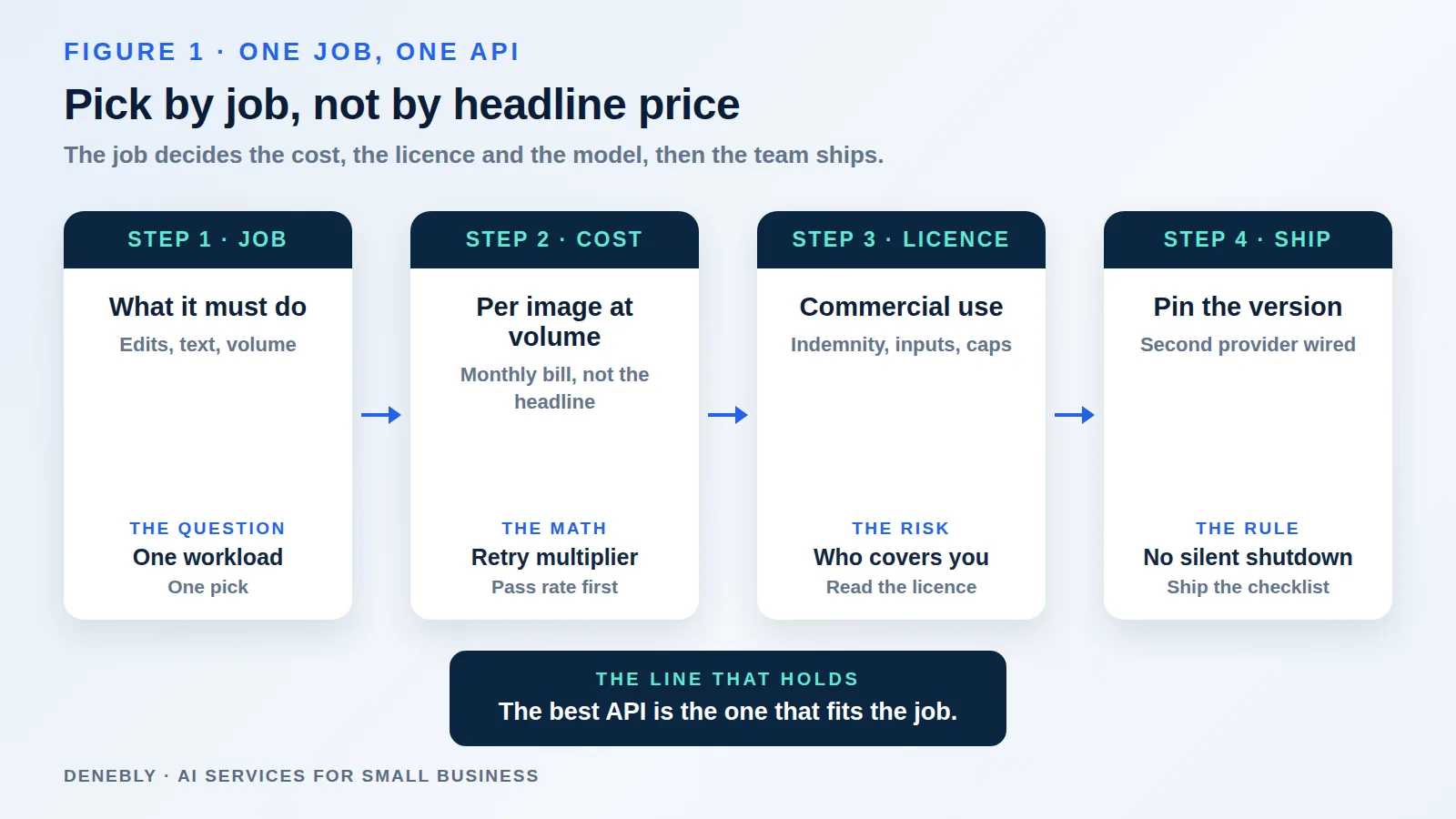
The best ai image generation api is the one that fits your product exact job, measured on per-image cost at real volume, editing behaviour, latency, licensing and model lifecycle, not the one with the lowest headline price.
If you would rather hand that choice to one accountable team, our generative AI team builds image features this way.
What the best image generation API means for your product
There is no single best image generation API, only the best fit for a job. A product photo pipeline needs consistent edits and clean licensing. A marketing tool needs cheap volume and fast drafts. A design app needs reference images and multi-pass editing.
Five criteria decide which image generation api for your product is the right one, and price is only one of them. Cost at real volume, editing behaviour, latency, licensing and indemnity, and model lifecycle. The rest of this article scores the main APIs on those five.
One warning up front. The cheapest headline price is rarely the cheapest bill. A 0.003 dollar image that needs three retries costs more than a 0.04 dollar image that passes first time.
Provider vs model, the distinction that decides your bill
An image generation API is either a provider or a model, and mixing the two up is the most common buying mistake. OpenAI, Google and Black Forest Labs sell their own models direct, while fal and Replicate sell access to many models through one key.
The distinction decides what you are locked into. A direct model API locks you to one model family and its deprecation dates. A hosted catalog lets you swap models without rewriting the integration, but adds a second price layer. Techsy, with live June 2026 pricing, makes the same split.
Ask it this way. If the model changes, does your code change. With a direct API, yes. With a catalog, usually no. The best image generation api for developers is the one that survives a model shutdown, not the one with the lowest price.
The pick by job table, one API per workload
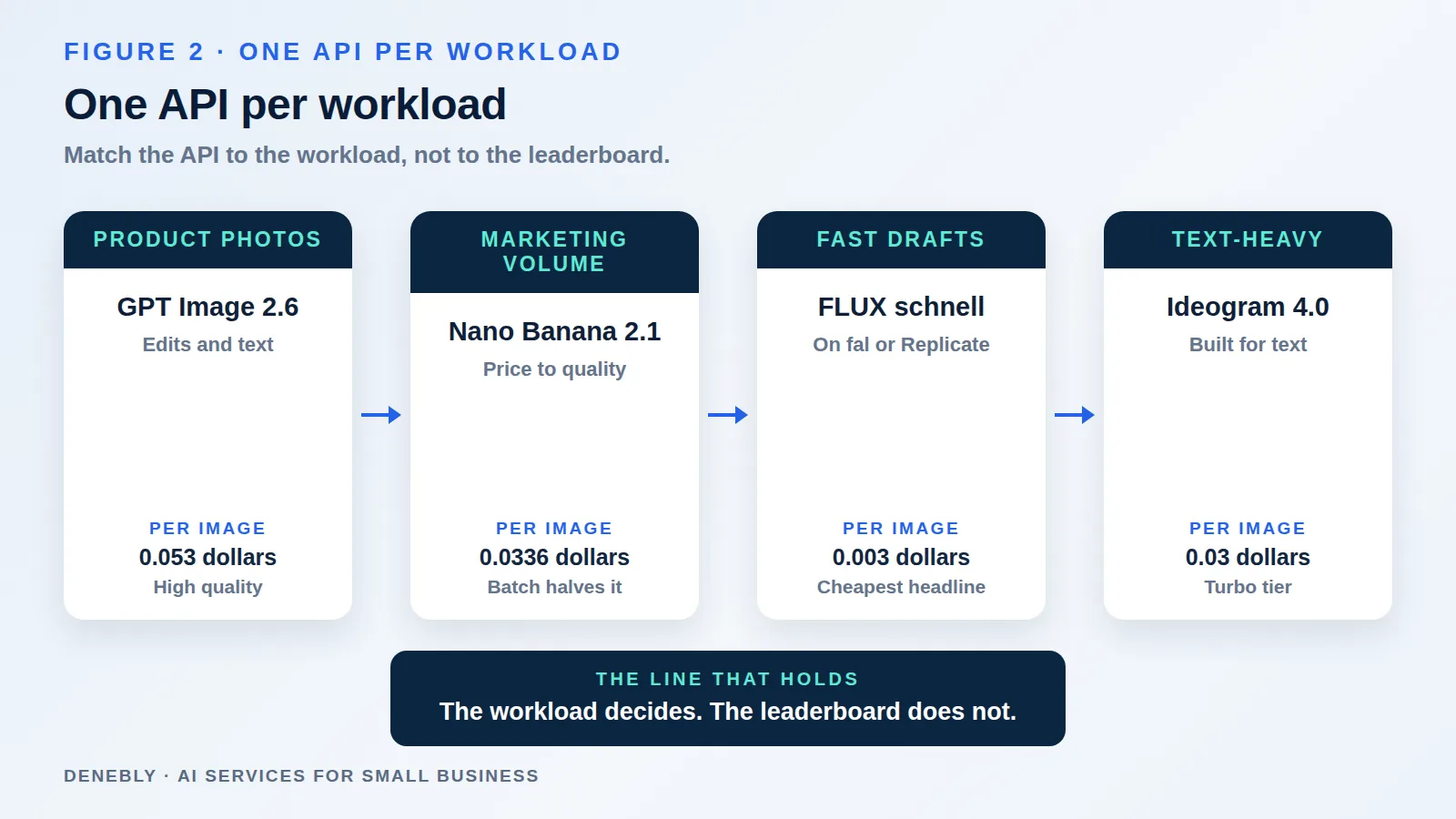
Start here if you want the short answer, the top image generation api for each workload. Each row names one workload, one API, and the reason. The sections after the table give the evidence.
| Workload | Pick | Why |
|---|---|---|
| Product photos with edits | GPT Image 2.6 | Edits in passes, clean text |
| Marketing images at volume | Nano Banana 2.1 | 0.0336 dollars per 1K image, batch halves it |
| Fast drafts and tests | FLUX schnell on fal | 0.003 dollars an image, no free tier needed |
| Text-heavy images | Ideogram 4.0 | Built for text in images, Turbo 0.03 dollars |
| Open-weight control | FLUX.2 klein on Replicate | 0.014 dollars, swap models on one key |
No row is a lifetime pick. Prices change, models shut down, and a workload past 50,000 images a month flips the maths toward flat plans. Revisit the table every quarter.
OpenAI GPT Image, the editing and text specialist
GPT-Image-2.6, released 4 to 5 November 2026 as Flare and Sunburst, is the strongest general pick for products that edit images in passes. It takes a reference image, follows an instruction, and returns an edited image.
The price is token billing, not per-image billing. The OpenAI model page, read November 2026, lists 5 dollars per 1M text input tokens, 8 dollars per 1M image input tokens, and 30 dollars per 1M image output tokens. Per 1024 by 1024 image that is about 0.025 dollars at low, 0.043 at medium, 0.053 at high, 0.094 at extra high, and 0.21 at max.
Two limits matter. Batch API is not supported for 2.6, and the older models are gone, gpt-image-1 shut down 23 October 2026, and gpt-image-1-mini and 1.5 shut down 1 December 2026.
APIBenchmarks, the only scored index in the research, ranks OpenAI first of seven APIs at 90.5, grade A, on documentation, reliability, ecosystem and accessibility. That score rates the API, not the images.
Google Nano Banana, the price to quality balance
Nano Banana 2.1 is the price-to-quality pick. It costs 0.0336 dollars per 1K image, 0.0504 at 2K, and 0.113 at 4K, with batch mode halving each, so 1K drops to 0.0168 dollars for work that can wait. The Pro tier runs 0.134 dollars per 1K or 2K image.
Do not build on Imagen. Imagen 4 retired from the Gemini API on 17 August 2026, and the original Nano Banana, Gemini 2.5 Flash Image, shuts down 15 March 2027.
The trade-off against OpenAI is editing depth. Nano Banana handles reference images and quick edits well, and at a third of the GPT Image high-quality price it is the right pick for marketing volume.
There is no free tier for image models in the Gemini API. Budget for the first thousand images from day one.
Black Forest Labs FLUX, direct access and open weights
Black Forest Labs sells FLUX direct, and it is the open-weight route. FLUX 3 Image costs 0.048 dollars per 1K image. FLUX.2 klein 4B costs 0.014 dollars, the 9B costs 0.015, pro costs 0.03 dollars per megapixel, flex 0.05, and max 0.07. FLUX1.1 pro costs 0.04 dollars per image direct.
The open-weight advantage is control. You can run the model, fine-tune it, and swap versions without asking a vendor. The cost is that you carry the hosting, the scaling, and the licence terms yourself, including the revenue caps some open weights carry. Eden AI licence table lists those caps side by side.
One billing detail helps. Failed or moderated generations are not billed, so a prompt that gets blocked costs nothing. That matters when a product generates thousands of images a day.

fal and Replicate, one key for many models
fal and Replicate are catalogs, one key, many models, and they win on speed of change. FLUX.1 schnell costs 0.003 dollars per megapixel on fal, about 0.003 dollars per 1MP image, and the same on Replicate. Flux Dev costs 0.025 dollars per image on Replicate, Flux Pro 0.04.
The billing unit is the megapixel, and each image rounds up to a whole megapixel. A 1024 by 1024 image is 1MP, so it costs 0.003 dollars. A larger image costs more in whole-megapixel steps.
Two limits matter. Neither offers a free tier, and Replicate warns of cold starts of 20 to 60 seconds on idle models, which rules it out for anything that must answer at once. For batch work and model tests, the catalogs are the cheapest way to compare models.
APIBenchmarks ranks fal third at 82.6 and Replicate fourth at 80.2 of seven APIs on the API score. The scores rate the platform, not the images, and the platform is what you are buying here.
Stability AI, Ideogram and Leonardo, the specialists
Stability AI is the fine-tuning specialist. One credit is 0.01 dollars. Stable Image Core costs 3 credits, 0.03 dollars, and Stable Image Ultra costs 8 credits, 0.08 dollars. New accounts get 25 free credits, and a 20 dollar a month membership bundles 6,000 credits.
Ideogram is the text specialist. Ideogram 4.0 Turbo costs 0.03 dollars per image, Default 0.06, and Quality 0.10. If the image carries a headline, a label, or a logo, Ideogram is the pick. APIBenchmarks ranks Ideogram last of seven at 61.2, grade D, on the API surface, not the text quality.
Leonardo AI is the pay-as-you-go specialist. There is no subscription, the balance does not expire, and the price varies by model and settings, so use their calculator before you budget. No free API allowance is documented.
What one image costs, short summary with a link to the pricing post
The table below is a short summary at one 1024 by 1024 image. For the full per-image table and the volume maths, read our guide to AI image generation API pricing.
| API | One 1024 image | Billing unit |
|---|---|---|
| FLUX schnell on fal or Replicate | 0.003 dollars | Per megapixel |
| Nano Banana 2.1 | 0.0336 dollars | Per 1K image |
| GPT Image 2.6 high | 0.053 dollars | Per token |
| Nano Banana Pro | 0.134 dollars | Per 1K image |
| GPT Image 2.6 max | 0.21 dollars | Per token |
The spread is about 70 times from the cheapest to the dearest on the same square size, 0.003 dollars to 0.21 dollars. That is why the workload, not the leaderboard, decides the pick.
What a month of images costs, three volumes with the retry multiplier
A per-image price is not a monthly bill. The table below runs three realistic volumes through four APIs.
| Images a month | FLUX schnell | Nano Banana 2.1 | GPT Image high | Nano Banana Pro |
|---|---|---|---|---|
| 1,000 | 3 dollars | 33.60 dollars | 53 dollars | 134 dollars |
| 10,000 | 30 dollars | 336 dollars | 530 dollars | 1,340 dollars |
| 100,000 | 300 dollars | 3,360 dollars | 5,300 dollars | 13,400 dollars |
Then apply the retry multiplier. Magic Hour, read 22 November 2026, gives the formula, accepted-image cost equals all billed attempts plus storage, egress, review and correction, divided by accepted images. Its worked example runs 20 requests at 0.04 dollars, and if 8 images pass, the cost per accepted image is 0.10 dollars, not 0.04.
A quoted 0.04 dollar request is not a guaranteed 0.04 dollar usable image. Measure your own pass rate for a week, then multiply the table above by one over that rate.
At very high volume the maths flips again. ModelsLab, updated 15 October 2026, shows flat plans winning above about 50,000 images a month, with its Standard plan at 47 dollars a month for 10,000 calls. Past that volume, compare flat plans, not per-image prices.
Editing, references and multi-pass work
Most product features do not generate one image and stop. They generate, edit, and generate again, and the API that handles edits well wins the job.
GPT Image leads on multi-pass editing. It takes a reference image and an instruction, returns an edited image, and keeps the rest stable across passes. FLUX Kontext Pro, at 0.04 dollars per image on fal, is the open-weight editing route.
An ai image api for product photos must hold the product steady across passes. Run the same edit three times in a row, a background change, a text fix, and a colour change, and count how many passes keep the product intact.
Text in images is a separate test. Ideogram and GPT Image render clean headlines and labels, while most open-weight models still garble short words.
Licensing, indemnity and commercial use
The licence decides whether you can sell what the API makes. Three questions cover it, who owns the output, who indemnifies you if the output copies someone work, and what happens to your inputs.
OpenAI and Google both offer indemnity on their first-party models, OpenAI through its Copyright Shield and Google through Vertex indemnity, as Techsy notes in its June 2026 comparison. That cover applies to the vendor model, not to a fine-tuned or third-party model.
Open-weight models pass the licence through to you. Some carry revenue caps, and some restrict commercial use, so read the model licence and the API terms.
Inputs matter too. Ask each vendor whether your prompts and images train their models, and how long outputs are stored. A vendor that trains on your inputs is a poor fit for a product that handles customer photos.
Midjourney has no API, what to use instead
Midjourney has no public API. Four sources read in September to November 2026 agree, no API key, no official SDK, and no published rate card. Subscriptions run 10, 30, 60 and 120 dollars a month for human use.
The terms of service, effective 27 May 2026, prohibit automated tools. Unofficial wrappers thinned out in 2026, ApiFrame still operates, GoAPI discontinued its Midjourney service, and PiAPI exited Midjourney.
Match the replacement to the reason you wanted Midjourney. For the look, FLUX.2 pro on fal or Replicate gives a close style at 0.03 dollars per megapixel. For quality at volume, Nano Banana Pro at 0.134 dollars per 1K image. For editing, GPT Image 2.6.
Deprecation risk, models that shut down in 2026
Models shut down, and a pipeline pinned to a dead model breaks without warning. 2026 saw a run of shutdowns, and the pattern is the selection criterion most buyers skip.
| Model | Shut down |
|---|---|
| DALL-E 2 and DALL-E 3 | 12 May 2026 |
| Imagen 4 on the Gemini API | 17 August 2026 |
| gpt-image-1 | 23 October 2026 |
| gpt-image-1-mini and 1.5 | 1 December 2026 |
| Gemini 2.5 Flash Image | 15 March 2027 |
Two rules protect a pipeline. First, pin the model version in your code, never call a floating alias in production. Second, keep a second provider wired and tested, so a shutdown is a config change, not a rebuild.
Ask the vendor for a deprecation notice period before you sign. A vendor that gives 90 days is a different risk from a vendor that gives 30.
The five-question decision tree
Answer five questions about the job, in order, and the tree gives one API and a runner-up. It is a copyable template, not a verdict.
- Does the job need edits in passes. Yes goes to GPT Image 2.6.
- Does the image carry text a customer reads. Yes goes to Ideogram 4.0.
- Is the volume above 10,000 images a month. Yes goes to Nano Banana 2.1 with batch mode.
- Does the job need a model you can fine-tune or swap. Yes goes to FLUX on fal or Replicate.
- Is the budget under 0.01 dollars an image. Yes goes to FLUX schnell, no goes to Nano Banana 2.1.
The runner-up is the second name on the branch you left. Keep the runner-up wired, so a price change or a shutdown costs a config change, not a rebuild. Our AI product development team runs this tree with teams before they commit.
Production checklist before you ship
Ship nothing until every line below is true.
- Model version pinned. No floating alias in production.
- Second provider wired. A failover API is tested, with its own key and budget.
- Rate limits handled. Retries back off, and the bill has a spend cap.
- Idempotency on. A retried request never bills twice or creates a duplicate image.
- Webhooks live. Generation completion and failure both arrive without polling.
- Spend cap set. The dashboard caps the month, and an alert fires at 80 percent.
- Licence checked. Commercial use, indemnity, and input training are confirmed in writing.
- Output stored. Generated images land in your own storage, not only on a vendor URL.
Run the checklist again after any vendor change, a price rise, or a terms update. A pipeline that passed in June can fail in December.
Mistakes that cost teams money
- Picking by headline price. A 0.003 dollar image with a 50 percent pass rate costs more than a 0.04 dollar image that passes first time.
- Calling a floating alias in production. A model update changes the output overnight.
- Skipping the licence read. An open-weight model with a revenue cap is a lawsuit waiting for a successful product.
- Forgetting the retry multiplier. The budget covers the first attempt, and the retries arrive as a surprise.
- Building on a Midjourney wrapper. The vendor can cut it off without notice.
- No second provider. A shutdown or an outage stops the product.
For a second pair of eyes on a vendor shortlist, start through our contact page and bring the shortlist.
Frequently asked questions
What is the best ai image generation api
It is the API that fits your product exact job, measured on per-image cost at real volume, editing, latency, licensing and model lifecycle. For product photos it is GPT Image 2.6, for marketing volume Nano Banana 2.1, and for fast drafts FLUX schnell on fal.
What is the cheapest image generation API
FLUX schnell on fal or Replicate at 0.003 dollars per image is the cheapest headline price read 22 November 2026. The cheapest accepted image is a different number, apply your pass rate first.
How much does GPT Image cost per image
GPT-Image-2.6 bills by token, 5 dollars per 1M text input tokens, 8 dollars per 1M image input tokens, and 30 dollars per 1M image output tokens. Per 1024 by 1024 image that is about 0.025 dollars at low, 0.043 at medium, 0.053 at high, 0.094 at extra high, and 0.21 at max.
Which image API is best for text in images
Ideogram 4.0, Turbo at 0.03 dollars per image, is built for text in images, and GPT Image 2.6 is the runner-up. Test the exact headline your product prints.
Does Midjourney have an API
No. Midjourney has no public API as of November 2026, no API key, no official SDK, and no published rate card, and its terms prohibit automated tools. Use FLUX.2 pro for the look, or GPT Image 2.6 for editing.
Should I use Google Imagen for a new integration
No. Imagen 4 retired from the Gemini API on 17 August 2026. Use Nano Banana 2.1 at 0.0336 dollars per 1K image, or Nano Banana Pro at 0.134 dollars for the higher tier.
Sources
- OpenAI model page, GPT-Image-2.6 token rates, read November 2026. OpenAI pricing
- Vendor and comparison pages read 22 November 2026, Eden AI, Unite.AI, APIBenchmarks, Magic Hour, Novita AI, ModelsLab, Techsy and Apihiver.
- Model shutdown dates as cited by Apihiver, Eden AI and Magic Hour, DALL-E 12 May 2026, Imagen 4 17 August 2026, gpt-image-1 23 October 2026.

WRITTEN BY
Arslan Mushtaq
Founder, Denebly
Arslan founded Denebly in 2018 and leads its AI development work for startups and mid-size businesses, across AI chatbots, agentic workflows, RAG systems, machine learning and automation. Denebly has delivered 100+ projects from Dallas, Texas.
Ready to Solve Your Business Problems With AI?
Tell us what you are trying to build, automate or fix. You will get an honest assessment within one business day, not a sales pitch.