Insights
AI Video Generation API Pricing: Per-Second and Per-Video Costs Compared
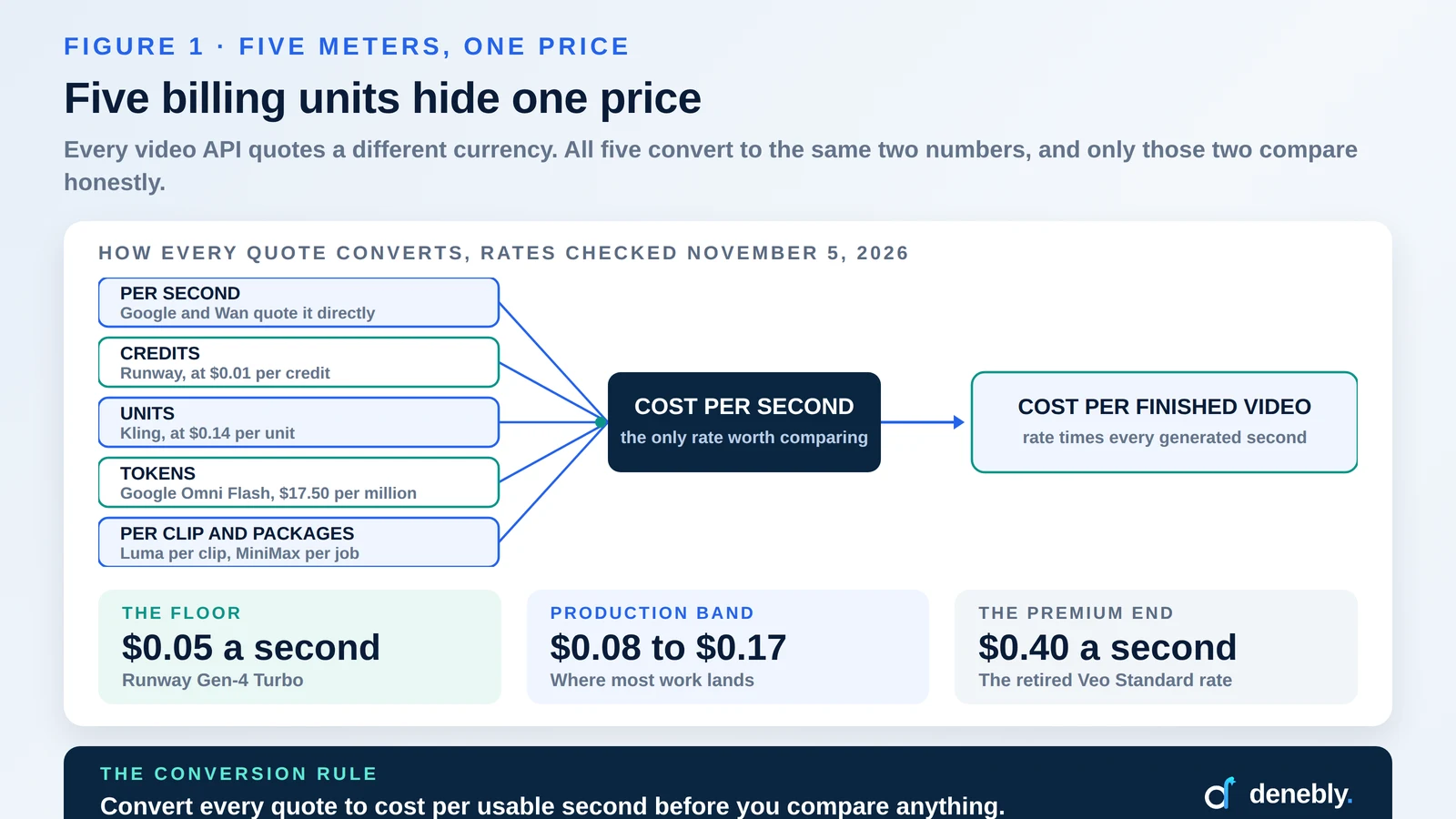
Ask five video API vendors what a ten second clip costs and you will get five answers in five different currencies: credits, units, tokens, per clip prices and package points. The clip is the same. The settings are similar. The bills, once you convert them, run from fifty cents to four dollars, and that is before the retakes every real production needs.
This guide converts ai video generation api pricing into the two units that matter, cost per second and cost per finished video, at rates checked on November 5, 2026. It also covers the subject most pricing pages avoid: two of the flagship APIs in last year’s comparisons no longer exist, and that churn is now part of the price.
AI video generation API pricing in November 2026 runs from about $0.05 to $0.40 per second at published rates. Runway Gen-4 Turbo and the retired Veo Lite tier sit at the $0.05 floor, most production work lands between $0.08 and $0.17 per second, and the honest comparison unit is cost per usable second after retakes, not the sticker rate.
Key takeaways:
- Five billing units hide one price. Credits (Runway at $0.01 each), units (Kling at $0.14 each), tokens (Google Omni Flash at $17.50 per million), per clip prices (Luma) and prepaid packages (MiniMax) all convert to a per second rate at your settings.
- Google retired the Veo 3.1 preview APIs on October 22, 2026 and OpenAI shut the Sora API on September 24, 2026. Any comparison still pricing them as live options is out of date, including several that rank for this topic.
- Retakes decide the real bill. At 2.5 attempts per usable shot, a 30 second ad costs $3.75 on the cheapest tier and $30 at the retired premium rate. Attempts cost more than the footage you keep.
- Per clip pricing changes how you shoot. Luma’s per clip rates make short shots cheap and long shots expensive; per second pricing is neutral to shot length.
- There is effectively no free tier. Google, Pika and Luma all state paid access for production API use; budget for paid testing from day one.
When a pricing model is this easy to misread, the build matters as much as the model choice. Our generative AI development work includes a cost model per product, with the draft and finish tiers, the retake allowance and the exit route priced in before the first integration is written.
What follows: the five billing models decoded, the checked price table across the major APIs, the Veo and Sora retirements and what they mean for anyone who built on them, a worked example of a finished 30 second video, the settings that push bills up, how to cut cost without cutting quality, and the mistakes buyers repeat.
What Is AI Video Generation API Pricing?
AI video generation API pricing is what a developer or business pays, per call, to generate video from a text prompt, an image, or both, through a programming interface rather than a consumer app. The distinction matters commercially: the app subscription and the API are separate products with separate balances at nearly every vendor, and app credits do not transfer to API use at Runway or Kling. If a price you found does not say which product it belongs to, it is not yet a usable price.
Three variables set every rate in this market. The model tier (a fast draft model against a flagship), the output settings (resolution, duration, native audio, HDR), and the billing unit the vendor chose to quote. The same generation can be quoted as 12 credits, 1.2 units, 57,920 tokens or one clip, which is why this guide converts everything to dollars per second at stated settings, and then to dollars per finished video. The companion piece on the image side, our guide to AI image generation API pricing, uses the same method for stills; video adds the two complications of duration and retakes.
One quality anchor before the numbers: independent blind testing exists in this market. Artificial Analysis ranks text to video models by human preference votes; at the time of writing Alibaba’s Wan 3.0 leads its with audio board and MiniMax’s H3 sits third, both at mid market prices. Price and preference do not rise together in a straight line, which is exactly why the per second table below is worth reading carefully.
The Five Ways Video APIs Charge You
Every ai video generation api pricing page in this market uses one of five meters. Learn the meter and the marketing loses its power.
Per second. The honest unit. Google priced Veo per second; Alibaba prices Wan per second ($0.10 at 720p list, with a stated 30 percent promotion running). What you generate is what you pay for, at the resolution you chose.
Credits. Runway and Kling’s consumer apps sell credits and spend them per second at model specific rates. On Runway’s developer platform the credit is at least a stable currency: $0.01 each, 5 per second for Gen-4 Turbo, 12 for Gen-4.5. In consumer apps the credit’s dollar value changes with the plan you bought it in, which is where comparisons go to die.
Units. Kling’s official API sells units at a $0.14 list price, in prepaid packages starting at $700 for 5,000 units. The per second rates behind the units are reasonable ($0.084 per second at 720p without audio) but you cannot see them until you do the division yourself.
Tokens. Google’s current model, Gemini Omni Flash, bills video as output tokens: $17.50 per million, with one second of 720p video consuming 5,792 tokens. Google does the conversion for you on its pricing page and calls it approximately $0.10 per second. Token billing also means input costs (prompts, reference images and video) appear on the same bill as small separate lines.
Per clip and packages. Luma prices per clip: a 5 second 720p clip is $0.30 and a 10 second clip is $0.90, so the per second rate rises with clip length. MiniMax prices per job and sells prepaid point packages (a $1,000 package of 3,760 points, valid one month) that bring its effective rate down only if you use the whole package.
The Checked Price Table: Every Major API
Rates below were checked on November 5, 2026. Google’s were read on its official pricing page the same day. Other vendors’ rates were corroborated across at least two independent readings of the official pages from October or November 2026, because several vendor pages show no prices to a text reader. Every figure is converted to a 10 second clip at the stated settings for comparison.
| Provider and model | Billing unit | Checked rate | What a 10 second clip costs |
|---|---|---|---|
| Runway Gen-4 Turbo | Credits at $0.01 | 5 credits per second, $0.05 | $0.50 |
| Runway Gen-4.5 | Credits at $0.01 | 12 credits per second, $0.12 | $1.20 |
| Google Gemini Omni Flash | Tokens | $17.50 per million output tokens, about $0.10 per second at 720p | About $1.00 plus small input costs |
| Kling 3.0 (official API) | Units at $0.14 | $0.084 per second at 720p silent; $0.168 at 1080p with native audio; $0.42 at 4K | $0.84 to $1.68 at the stated settings |
| Luma Ray (Ray3.2) | Per clip | $0.30 per 5 second clip at 720p; $1.20 at 1080p; HDR doubles it | $0.90 at 720p; $3.60 at 1080p |
| MiniMax Hailuo 2.3 | Per job / package points | $0.28 per 6 second job at 768P, about $0.047 per second; package rates lower if fully used | About $0.47 at 768P, job lengths differ |
| Alibaba Wan 3.0 | Per second | $0.10 per second at 720p list; $0.20 at 1080p; promotion running at check time | $1.00 at 720p list |
| Google Veo 3.1 (RETIRED October 22, 2026) | Per second | Last published: Lite $0.05, Fast $0.10, Standard $0.40 at 720p | $0.50 / $1.00 / $4.00 at last rates |
| OpenAI Sora API (RETIRED September 24, 2026) | Per second | Last reported: $0.10 base, $0.30 to $0.50 Pro | $1.00 to $5.00 at last rates |
Read the table with its settings attached. Kling’s range is one model at four settings, not four models. Luma’s 1080p number is a per clip price for a 10 second clip; its 5 second clips cost a third of that. MiniMax’s job length is 6 seconds at 768P, not 10 at 720p, so its row is an approximation and is labelled one. Apples to apples is a discipline, not a default, in this market.
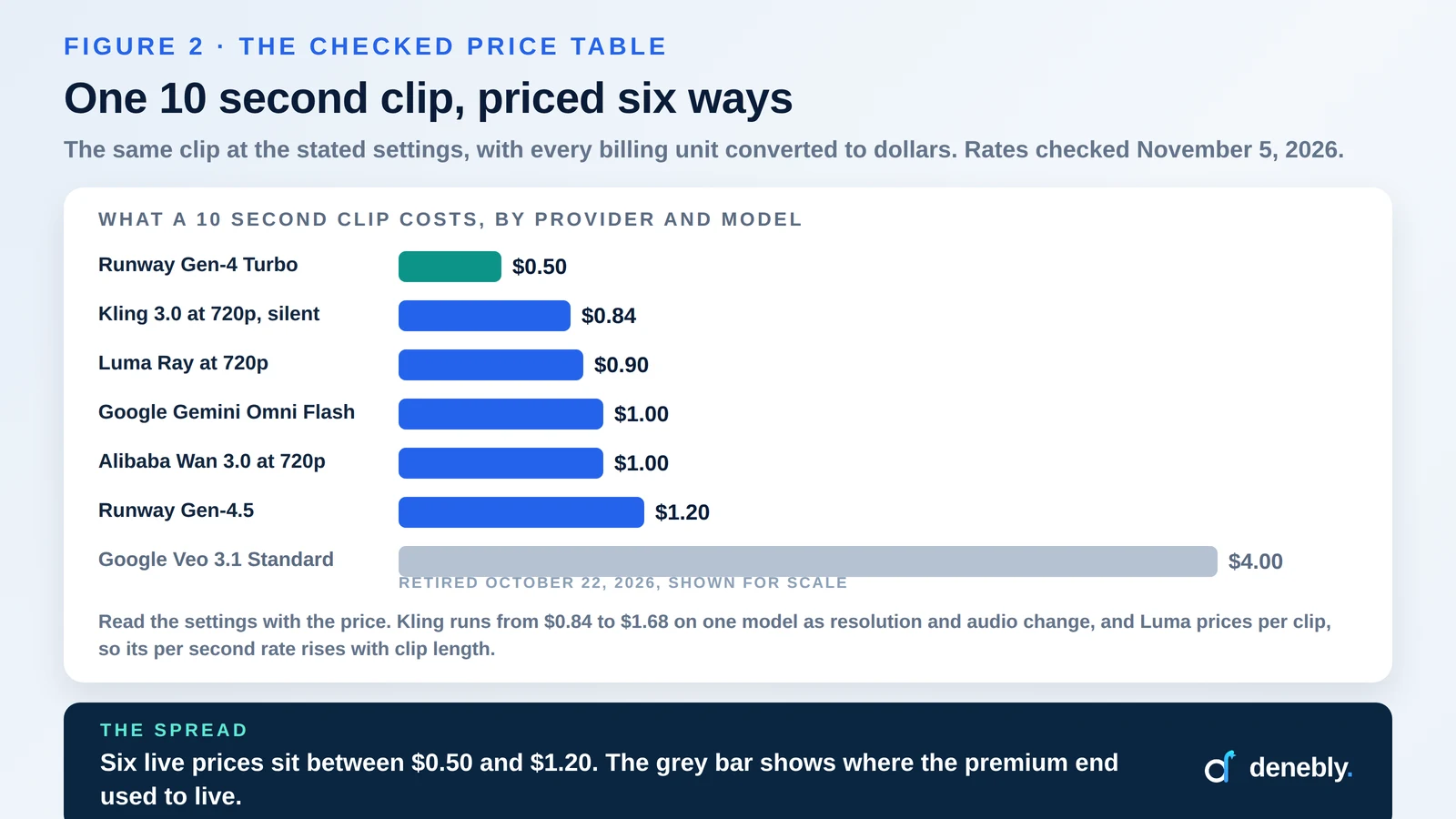
Figure 1: One 10 second clip at six checked rates. The figure converts each vendor’s billing unit to dollars at the stated settings; it cannot show quality differences, which the Artificial Analysis leaderboard in Sources covers independently.
Google Retired Veo: The Churn Problem Nobody Prices In
On October 22, 2026, Google shut down the Veo 3.1 preview models on the Gemini API. Its deprecations page named Gemini Omni 1.1 Flash as the replacement, and its pricing page now lists Omni Flash as the video generation model: token billed, approximately $0.10 per second at 720p, paid tier only. A month earlier, on September 24, 2026, OpenAI shut down the Sora API with no official replacement. Two flagship video APIs, gone within four weeks of each other.
We price this into client work now, and in our generative AI services the model layer is built to be swapped: prompts, reference handling and billing behind one internal interface, with a second model qualified before launch. The teams that treated Veo’s $0.40 rate as a permanent input to their unit economics are re-platforming in a hurry this quarter.
For buyers, the lessons are concrete. Never hard code one model into pricing you quote your own customers. Prefer vendors whose rate card lists several models, including other vendors’ models (Runway’s card resells Kling and others), because substitution is then a configuration change. And date every price you plan around: ai video generation api pricing has a shorter shelf life than any other input in a typical product budget. The rates in this article were checked on November 5, 2026 and will drift; the method will not.
Credits, Units and Tokens: Converting to One Number
The conversion routine is always the same. Take the vendor’s unit price, multiply by the units one second of your output consumes at your settings, and you have the only rate worth comparing. Three worked conversions from the table:
Runway Gen-4.5: 12 credits per second at $0.01 per credit is $0.12 per second. Kling 3.0 at 1080p with native audio: the official per second price behind the units is $0.168, which is 1.2 units per second at the $0.14 unit price. Gemini Omni Flash: 5,792 tokens per second at $17.50 per million tokens is $0.101 per second, before the small input token lines.
Two traps inside conversions. First, the same brand can run two currencies: Kling’s consumer app credits (bought at $1 for 66) are not Kling API units ($0.14 each), and a 12 credit per second app rate and the API’s $0.168 per second are different products wearing one name. Second, resolution and audio multipliers hide inside the unit count, not the unit price: Kling’s silent 720p rate is $0.084 and its 1080p with audio rate is exactly double, Luma’s HDR is a clean 2x, and Veo priced 4K at one and a half times its 720p rate. When a vendor says the price did not change, check the units per second before you believe them.
Aggregators add a third layer to the same purchase. Resellers such as fal.ai and Replicate host the same models at their own rates, sometimes matching the vendor (Veo at $0.40 per second while it lived) and sometimes above it (Veo Fast at $0.15 against Google’s $0.10). The premium buys one integration and one bill across many models, which for plenty of teams is worth paying. Just know that you are paying it, and know the direct rate you are marking up from, because the gap is where an informed buyer negotiates or switches routes.
What Does AI Video Generation API Pricing Mean for a Finished Video?
Nobody ships the first generation. Professional workflows generate several attempts per shot and keep one, so the finished video’s cost is the per second rate multiplied by total generated seconds, including the attempts in the bin. Here is the standard worked example used throughout this guide: a 30 second video built from six 5 second shots, at 2.5 attempts per usable shot, which is 75 generated seconds or 15 clips. The attempts figure is an assumption, stated openly; independent comparison work in this market has used 3 attempts for the same calculation. Measure your own and substitute it.
| Route | Basis | Cost of the 30 second video |
|---|---|---|
| Runway Gen-4 Turbo | 75 seconds at $0.05 | $3.75 |
| Luma Ray at 720p | 15 clips at $0.30 | $4.50 |
| Google Gemini Omni Flash | 75 seconds at about $0.10, plus input tokens | About $7.50 |
| Runway Gen-4.5 | 75 seconds at $0.12 | $9.00 |
| Kling 3.0 at 1080p with audio | 75 seconds at $0.168 | $12.60 |
| Google Veo 3.1 Standard (retired) | 75 seconds at $0.40, its last published rate | $30.00 |
Two conclusions survive any attempts assumption. The spread between the cheapest credible route and the premium tier is roughly eight to one on identical output length, so model and tier choice is the largest cost decision in the pipeline. And the attempts multiplier applies to every row equally, which means prompt craft, reference images and shot design, the unglamorous work of getting usable footage in fewer tries, is a pricing feature. A team that cuts its attempts rate from 3 to 2 saves a third of its generation bill on any vendor.
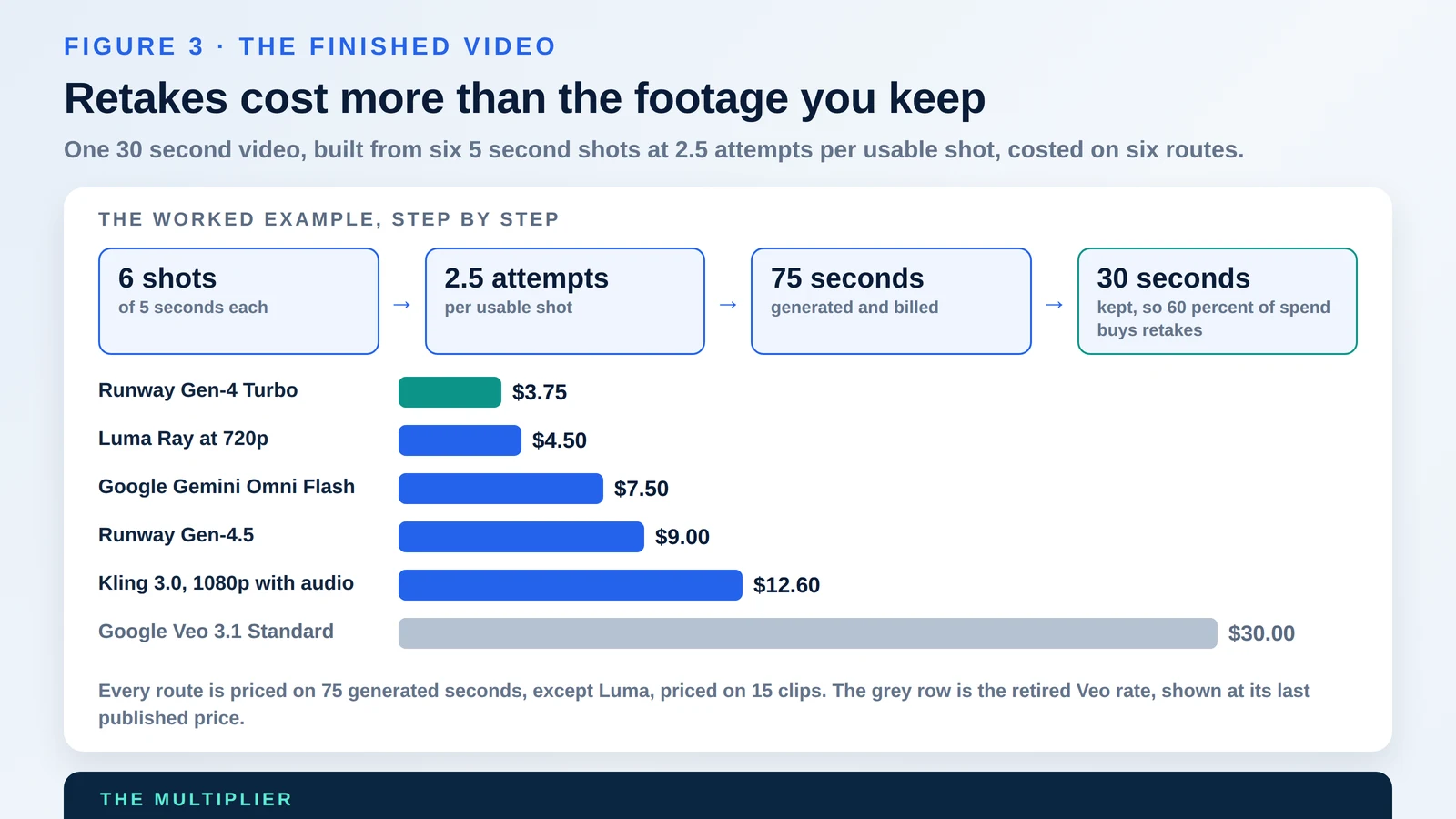
Figure 2: The worked example from the table above. The 2.5 attempts assumption is stated in the figure itself; substitute your own measured rate before budgeting, because it moves every row by the same multiplier.
What Pushes the Bill Up
Resolution is the obvious multiplier: 1080p typically runs at double the 720p rate where both are offered (Kling $0.084 to $0.168 with audio is resolution and audio together; Wan doubles cleanly from $0.10 to $0.20), and 4K runs from $0.30 to $0.60 per second where it exists. Native audio adds a third to a half at Kling and is simply always on, and always priced in, at Google. HDR doubles Luma. Input video and reference video are billed as consumption at token priced vendors and as extra credit seconds on Runway’s card for some third party models.
The quieter half of ai video generation api pricing is structural. Minimums and packages: Kling’s API starts with a $700 prepaid package, MiniMax’s best rates assume a $1,000 package used in full within a month, and unused package capacity is a cost, not a saving. Failed generations are billed by most vendors unless the failure is on their side; Google has stated that some audio processing failures are not billed, which is the exception that proves the rule. Storage, upscaling and delivery sit outside generation pricing entirely. A budget built only from the rate card is a budget for the first month of surprises.
How to Cut Cost Without Cutting Quality
The controls that work in ai video generation api pricing are boring and compounding:
- Draft on the cheap tier, finish on the flagship. Storyboard and timing passes on a $0.05 per second model, final renders of approved shots only on the tier you ship. Most pipelines find 70 percent or more of generated seconds are drafts.
- Fix the attempts rate before the rate card. Reference images, locked character and product descriptions, and a shot list written for what models do well will cut attempts more than any negotiation.
- Match clip length to the billing unit. On per clip pricing, design 5 second shots; on per second pricing, length is cost neutral, so shoot the length the edit needs.
- Buy packages only against measured usage. A package discount on capacity you do not use is the most expensive pricing in this market.
- Re qualify a second model quarterly. Rates move monthly and models retire; the Veo and Sora shutdowns are the recent proof. A tested fallback converts an emergency into a configuration change.
- Watch the settings defaults. Audio on, HDR on and 1080p defaults double bills silently in automated pipelines; set them deliberately per job type.
None of this needs a procurement department. It needs one owner of the generation bill who reads it weekly, which in the products we build is a dashboard line, not a monthly surprise. If your team would rather have the cost model designed once, properly, our free AI readiness audit includes a generation cost review for products already in production.
Mistakes Buyers Make With Video API Pricing
Comparing sticker rates across billing units is the classic error: a $0.28 MiniMax job and a $0.05 Runway second look comparable until you notice the job is 6 seconds at a lower resolution. The second error is pricing a product on generated seconds instead of usable seconds, which understates cost by the attempts multiplier and surfaces as a margin problem two quarters later. Third, mixing up the app and the API: teams prototype on a consumer subscription, read its credit rates as API prices, and build a budget on a product they are not buying. Every one of these mistakes is a way of reading ai video generation api pricing as simpler than it is.
Fourth, treating any rate as stable. Two flagship retirements in one month is the extreme case, but ordinary rate changes, promotion expiries (Wan’s 30 percent is explicitly limited time) and unit redefinitions happen constantly. Fifth, ignoring the independent quality evidence: the cheapest per second model that needs four attempts costs more than the mid priced model that needs two, and blind preference rankings exist precisely to stop buyers paying premium prices for footage audiences do not prefer.
Conclusion
AI video generation api pricing rewards buyers who convert everything to cost per usable second at their own settings, and punishes everyone else quietly, through retakes, defaults and packages. The current map is simple once converted: a $0.05 floor, a crowded $0.08 to $0.17 production band, premium tiers above it, and a market that retires its flagships without much warning.
If you are building video generation into a product and want the cost model, the fallback design and the integration done together, contact Denebly, write to sales@denebly.com or call +1 (214) 896-2906. Tell us the clip lengths, volumes and quality bar you are planning around, and we will reply within one business day with the per usable second model we would build on.
Frequently Asked Questions
What is ai video generation api pricing based on?
AI video generation api pricing is based on the model tier, the output settings and the vendor’s billing unit. The unit may be seconds, credits, API units, tokens or whole clips. Converting the unit price into dollars per second at your resolution, duration and audio settings is the only reliable way to compare vendors.
How much does it cost to generate a 10 second AI video through an API?
At rates checked on November 5, 2026, a 10 second clip costs $0.50 on Runway Gen-4 Turbo, about $1.00 on Google Gemini Omni Flash at 720p, $0.90 on Luma Ray at 720p, $1.20 on Runway Gen-4.5, and $0.84 to $1.68 on Kling 3.0 depending on resolution and audio. Retakes are extra on every route.
Which AI video API is cheapest per second?
Runway Gen-4 Turbo at $0.05 per second is the cheapest published rate among the major direct APIs checked for this ai video generation api pricing guide, a floor it shared with Google’s retired Veo Lite tier. MiniMax package pricing can calculate lower per second at 768P if a $1,000 package is used in full, and Pika lists $0.04 per second, so the honest answer depends on your resolution, volume and whether package minimums count.
Why did Google retire Veo 3.1, and what replaced it?
Google shut down the Veo 3.1 preview models on the Gemini API on October 22, 2026, and its documentation names Gemini Omni 1.1 Flash as the replacement. Omni Flash is generally available on the paid tier, bills video as output tokens at $17.50 per million, and works out to approximately $0.10 per second at 720p by Google’s own conversion.
Is there a free tier for AI video generation APIs?
Effectively no, for production use. Google lists no free tier for Omni Flash, Pika states it has no free tier, and Luma’s API is paid. Consumer apps offer small sign up or login credit allowances, sometimes watermarked or non commercial (Kling’s Basic plan is both), which are for evaluation, not for a product.
What is the difference between app credits and API pricing?
They are separate products with separate balances. Runway’s app subscriptions and its developer platform both use credits at $0.01, but the pools do not transfer. Kling’s consumer app spends credits bought at $1 for 66, while its official API spends units priced at $0.14 each. A price is only usable once you know which product it belongs to.
How do retakes change the real cost of AI video?
Retakes multiply the per second rate by your attempts per usable shot. At 2.5 attempts, a 30 second video built from six 5 second shots consumes 75 generated seconds, so a $0.12 per second model costs $9.00, not $3.60. Measuring your own attempts rate for a week gives you the multiplier your budget should actually use.
How often do AI video API prices change?
Constantly, and sometimes completely. OpenAI shut the Sora API on September 24, 2026 and Google retired the Veo 3.1 previews on October 22, 2026, while promotions like Wan’s 30 percent discount are explicitly time limited. Date every price you plan around, recheck quarterly, and keep a second model qualified so a change is a configuration update, not a rebuild.
Sources
- Artificial Analysis, “Text to Video Leaderboard” (AA-Video-T2V v2.1). The independent quality reference used above: blind human preference rankings with the benchmark API price per minute for each model (Wan 3.0 at $12.00, MiniMax H3 at $4.80 at their 1080p benchmark settings). It ranks preference, not value for your use case.
Vendor prices are cited in the text with their check dates and are not linked, per this site’s linking policy. Google’s rates and the Omni Flash token conversion were read on Google’s official Gemini API pricing page on November 5, 2026, and the Veo 3.1 shutdown and replacement were taken from Google’s deprecations documentation as reported the same week. Runway’s credit rates, Kling’s unit and per second rates, Luma’s per clip prices, MiniMax’s job and package pricing and Wan’s list prices were each corroborated across at least two independent readings of the vendors’ official pages from October or November 2026, because several of those pages render no prices to a text reader. Confirm the live rate, the billing unit and the settings multipliers before committing spend; in this market the method outlives every number in this article.

WRITTEN BY
Arslan Mushtaq
Founder, Denebly
Arslan founded Denebly in 2018 and leads its AI development work for startups and mid-size businesses, across AI chatbots, agentic workflows, RAG systems, machine learning and automation. Denebly has delivered 100+ projects from Dallas, Texas.
Ready to Solve Your Business Problems With AI?
Tell us what you are trying to build, automate or fix. You will get an honest assessment within one business day, not a sales pitch.