Best AI Bookkeeping Tools for Small Business
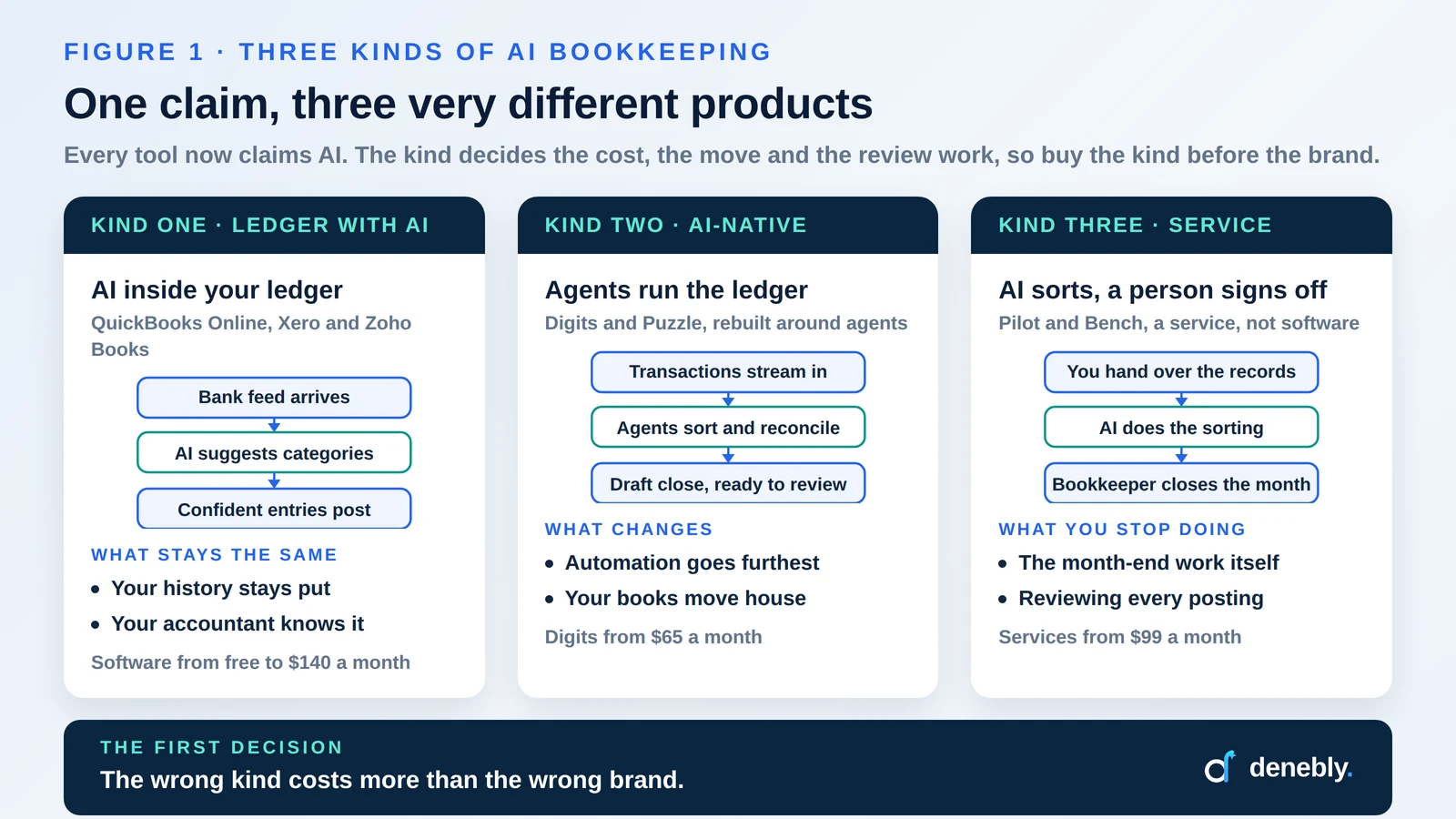
Every bookkeeping tool now claims AI. The claim hides three very different products, and picking the wrong kind costs more than picking the wrong brand. One kind adds AI to the ledger your accountant already uses. One kind replaces the ledger and asks you to move your books. One kind is not software at all, but a service where AI does the sorting and a person signs off.
This guide separates the three kinds, prices eight leading tools from their own pricing pages in November 2026, and shows the full first-year cost for one business, review time included. It also names the businesses that should not buy any of them yet.
Key Takeaways
- Buy the kind before the brand. AI inside your current ledger, an AI-native ledger, and a done-for-you service solve different problems.
- The subscription is the smallest cost. Cleanup, the plan upgrade the caps force, and your review time decide what year one really costs.
- No tool on this list removes the review layer. Budget for a human check every month, yours or a professional’s.
If your books are one piece of a bigger manual pile-up, our AI automation services look at the whole workflow first, invoicing, approvals and reporting included, before recommending a tool.
Three kinds of AI bookkeeping tool
Kind one is a standard ledger with AI built in. QuickBooks Online, Xero and Zoho Books read your bank feed, suggest categories and matches, and post the entries they are confident about. Your accountant already knows these ledgers, your history stays put, and the AI is a feature, not a move.
Kind two is an AI-native ledger. Digits and Puzzle rebuilt the general ledger around agents that categorize, reconcile and draft the close on their own. The automation goes further, but adopting it means migrating your books, and hoping your accountant follows you there.
Kind three is a service. Pilot and Bench pair AI sorting with human bookkeepers who review and close your month. You stop doing the work instead of doing it faster, and you pay service prices for that, from 99 dollars a month at Pilot Essentials to 199 dollars at Bench Light, on their October 2026 pricing pages.
Add-ons such as Booke AI, at 129 dollars a business a month on its own site, sit across kinds one and two, working the books inside QuickBooks or Xero for firms. Most small businesses need kind one or kind three. The rest of this guide scores all three on the same terms.
The shortlist at a glance
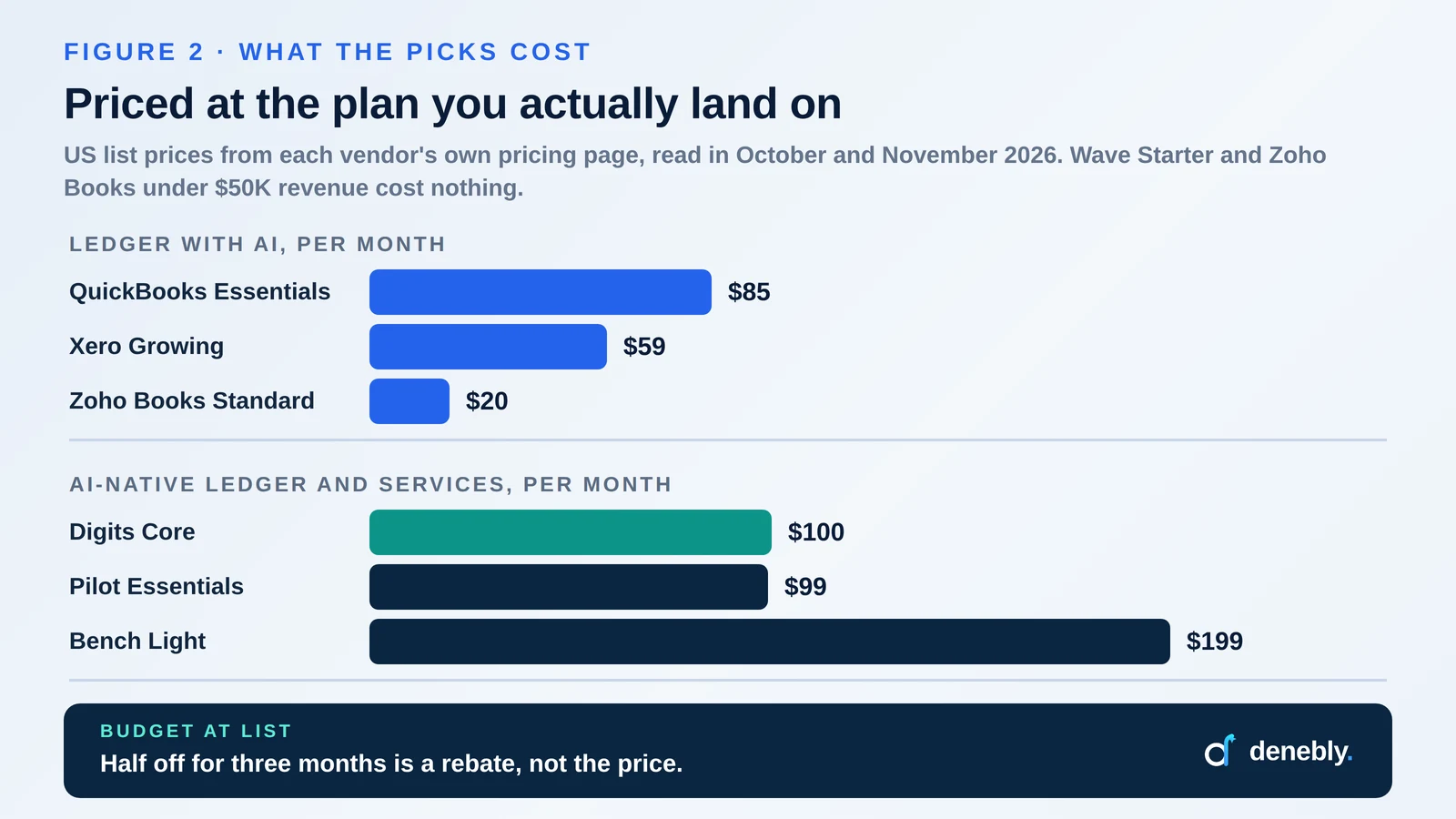
Eight tools, priced at the plan a small business actually lands on, not the entry tier. Prices are US list prices from each vendor’s pricing page, read in October and November 2026, before the new-customer promotions most of them run.
| Tool | Kind | Price a month | Best for |
|---|---|---|---|
| QuickBooks Online | Ledger with AI | $38 Simple Start, $85 Essentials | The default your accountant knows |
| Xero | Ledger with AI | $27 Early, $59 Growing | Teams, unlimited users, no per-seat fees |
| Zoho Books | Ledger with AI | Free under $50K revenue, $20 Standard | Tight budgets and Zoho users |
| FreshBooks | Ledger, invoicing first | $23 Lite, $43 Plus | Freelancers who live on invoices |
| Wave | Ledger, light AI | Free Starter, $19 Pro | Solo businesses starting out |
| Digits | AI-native ledger | $65 Essentials, $100 Core | Startups wanting books that run themselves |
| Pilot | Service, AI plus humans | $99 Essentials, Core from $299 | Founders who want a reviewer included |
| Bench | Service, human led | $199 Light, $399 Bookkeeping | Owners who want it off their desk |
The picks, tool by tool
QuickBooks Online is the safe default. Intuit’s AI agents post the familiar expenses they recognize with high confidence and queue suggestions for the rest, inside the ledger most US accountants already work in. Simple Start lists at 38 dollars a month on Intuit’s pricing page, read in November 2026, but one user and no bill tracking push most businesses to Essentials at 85 or Plus at 140. New customers get half off for three months. Budget at list, not at the teaser.
Xero is the cleaner ledger for teams. JAX, its AI assistant, answers plain-English questions about your numbers, and confident bank lines reconcile automatically once you switch the feature on. US prices rose on 1 October 2026 to 27 dollars for Early, 59 for Growing and 97 for Established, with no per-user fees on any plan, which makes Xero cheaper than QuickBooks the moment a second person logs in. Early caps you at 20 invoices and 5 bills a month, so Growing is the real starting point.
Zoho Books is the value pick. It stays free while your revenue is under 50,000 dollars a year, with 1,000 invoices included, and Standard costs 20 dollars a month, or 15 billed annually, on Zoho’s pricing page. Zia, its AI assistant, suggests the category, contact and account for bank lines, though Zoho labels the feature early access, so expect suggestions, not autopilot. The honest catch is the ecosystem. Fewer accountants run Zoho than QuickBooks or Xero, so check yours before you commit.
FreshBooks is invoicing software that grew a ledger, and it still shows. The AI helps with expense capture and categorization, but the reason to buy it is the billing experience your clients see. Lite lists at 23 dollars a month for 5 billable clients and Plus at 43 for 50, on FreshBooks’ pricing page, and every extra team member adds 11 dollars a month, which punishes growing teams. Skip it if you carry inventory or need serious reporting. Choose it if getting paid faster is the whole problem.
Wave is the free starting line. Starter costs nothing and covers unlimited invoices, bills and bookkeeping records, but you import bank transactions by hand. Pro, at 19 dollars a month or 190 a year on Wave’s pricing page, adds automatic bank imports and auto-categorization, receipt capture and payment reminders, which is where the AI story starts. Wave makes its money on payments, at 2.9 percent plus 60 cents a card transaction. For a solo business testing whether it needs bookkeeping software, free is the right price.
Digits is the boldest automation here. Its Agentic General Ledger categorizes and reconciles transactions around the clock and drafts the month-end close for review, which no add-on to QuickBooks can match. Essentials lists at 65 dollars a month and Core at 100, with no per-seat fees, on Digits’ pricing page. The price of admission is the move itself. Your books leave the ledger your accountant knows, the product serves US businesses in dollars only, and Digits’ accuracy figures are its own benchmarks, not an independent audit.
Pilot sells the outcome, not the tool. Bookkeeping Essentials, at 99 dollars a month on Pilot’s pricing page, is AI-led bookkeeping on a cash basis for businesses spending up to 100,000 dollars a month. Core adds a US-based bookkeeper who reviews your books and accrual accounting, and Pilot’s own blog puts Core from 299 dollars a month billed annually. That human layer is the point. If the thought of unreviewed AI postings near your tax return worries you, Pilot is the middle path between software and a hire.
Bench is a human bookkeeping service that uses software as its window. Bookkeeping Light costs 199 dollars a month for businesses under 250,000 dollars a year in revenue, and Bookkeeping costs 399, on Bench’s pricing page, with 20 percent off billed annually. Bench also carries the category’s hardest lesson. It shut down without warning in December 2024 and was bought by Employer.com days later, and it has operated since January 2025. Even a good service can vanish, so keep your own exports current whoever you hire.
Pick by the business you actually run
Feature lists will not choose for you. Your business shape will. Find your row, then score the named tool with the scorecard below before you pay.
| Your business | Start with | Why |
|---|---|---|
| Freelancer or solo consultant | Zoho Books Free, or Wave Pro | The books are simple, and free beats capable until invoices pile up |
| Service firm that lives on invoices | FreshBooks Plus | Billing polish and payment chasing matter more than ledger depth |
| Shop or ecommerce seller | QuickBooks Plus or Xero Growing | Inventory, sales channels and an accountant who knows the file |
| Startup raising or reporting to investors | Digits Core or Pilot Core | Accrual books and a close an investor can read |
| Team where several people touch the books | Xero Growing | Unlimited users with no per-seat fee keeps the bill flat |
| Owner who wants the job gone | Bench Light or Pilot Essentials | A person or a reviewed service owns the month-end, not you |
Finance teams feel this choice first, because the ledger feeds every report above it. See how we approach AI for finance and operations teams on our finance industry page.
What year one really costs
Subscriptions get compared. Totals do not. Here is the full first year for one business, labelled illustrative because the business is a composite, while every rate in it is a real published price.
Harbor Lane Interiors is an illustrative six-person staging and interiors firm, 480,000 dollars a year in revenue and about 350 transactions a month, moving from spreadsheets to Xero Growing.
| Cost line | Year one | Where the figure comes from |
|---|---|---|
| Subscription, Xero Growing | $708 | 59 dollars a month at list, Xero US pricing page, October 2026 |
| Cleanup and setup | $550 | 10 hours at 55 dollars an hour, the rate Bench lists for a QuickBooks-certified bookkeeper, applied to four messy months |
| Owner review time | $1,300 | 30 minutes a week checking AI categories, valued at 50 dollars an hour as a stated assumption |
| Year one total | $2,558 | Against 2,388 dollars for Bench Light alone at 199 a month |
Two lessons survive the arithmetic. First, the subscription is barely a quarter of the real cost, and review time is the biggest line, which is why a tool that explains its guesses beats a cheaper one that does not. Second, year two drops the cleanup, so the same setup costs about 2,008 dollars against 2,388 for the service, and the gap widens as your review gets faster. Our guide to invoice data extraction AI cost runs the same total-cost test on the invoice pile feeding these books.
Score any tool in ten minutes
Open the trial, work one real week of transactions through it, and score each line 0, 1 or 2. A tool under 10 points is not ready for your books. A zero on your accountant or on export ends the trial whatever the total says.
| Test | What earns a 2 |
|---|---|
| Bank feeds | Your banks and cards connect and stay connected for the full trial week |
| Categorization | Suggestions show their reason and corrections stick for the next similar transaction |
| Your accountant | Your accountant already works in it, or agrees in writing to start |
| Sales tax | It handles your states and your filing rhythm without a spreadsheet on the side |
| Payroll path | Payroll is built in, partnered, or cleanly handed off, at a price you have seen |
| Capture | Receipts and bills enter from a photo or an inbox, not by typing |
| Review workload | The weekly check fits in 30 minutes at your transaction volume |
| Exit | You can export the full ledger and documents today, in formats another tool reads |

When AI bookkeeping is the wrong buy
Some books should not be automated yet, and honest vendors will tell you so. If your records are a year behind and mixed with personal spending, an AI tool will categorize the mess at speed and give you confident, wrong reports. Pay for cleanup first, automate second.
Sales tax is the sharpest edge. Selling into several states creates filing duties that category suggestions do not settle, and a miscategorized taxable sale costs more than the subscription saves. Payroll is similar. Most tools treat it as an add-on or a partner product, priced separately, from 36 dollars a month plus 6 dollars a person on Xero’s Gusto-powered option to Zoho Payroll as its own subscription.
And when your situation turns on judgment, a human still wins. Loan applications, a sale of the business, a tax dispute, an investor audit. Working bookkeepers make the same point about accuracy. In one 2026 ranking’s research, a bookkeeper put it plainly, that accounting software cannot afford the inaccuracies AI is riddled with. That is overstated for routine categorization and exactly right for judgment calls.
Not sure whether your workflow is ready to automate at all? Our AI readiness audit checks the process before you spend on tools for it.
Mistakes that quietly cost money
- Buying the teaser price. Half off for three months, then list. Budget the year at list, and treat the discount as a rebate, not the price.
- Choosing against your accountant. The best tool is the one your accountant will actually open. A platform they refuse costs you a new accountant or a second set of books.
- Skipping the monthly review. AI posts what it believes. Fifteen unreviewed minutes a week is cheap. A year of unreviewed postings is a cleanup bill.
- Ignoring the caps. Twenty invoices on Xero Early, five billable clients on FreshBooks Lite, 1,000 invoices a year on Zoho Free. The cap, not the feature list, sets your real plan.
- Letting the only copy live with the vendor. Bench’s December 2024 shutdown stranded its customers mid-close. Export your ledger and documents monthly, whoever you use.
The rule to keep
Pick the kind first, score the tool on your own transactions, and budget the year at the full cost, review time included. Do that and the brand almost chooses itself.
If you would rather have the workflow assessed and the automation set up for you, let’s discuss your project. Write to sales@denebly.com or call +1 (214) 896-2906.
Questions businesses ask
What is the best AI bookkeeping tool for a small business?
For most, QuickBooks Online or Xero with their AI switched on, because your accountant already works there and nothing has to move. Zoho Books wins on price, Digits automates furthest if you accept a new ledger, and Pilot or Bench win when you want a person reviewing the month. The right answer is the kind first, then the brand.
How much does AI bookkeeping cost a month?
Software runs from free to about 100 dollars a month at small-business volumes, on the vendors’ own pricing pages in late 2026. Wave Starter and Zoho Books under its revenue limit cost nothing, Xero Growing is 59 dollars, and Digits starts at 65. Services with humans attached run from 99 dollars at Pilot Essentials to 649 dollars for Bench with tax filing.
Can AI bookkeeping replace a bookkeeper?
It replaces the typing, not the judgment. Categorization, matching and receipt capture are genuinely automated now. Choosing treatments, spotting the transaction that does not belong, and standing behind a tax position still need a person. Most small businesses land on software plus a monthly human review, which is exactly what Pilot Core and Bench sell.
Is AI bookkeeping accurate enough for tax filing?
Accurate enough to prepare, not to file unreviewed. The tools post what they are confident about and queue the rest, but a wrong category repeated for a year becomes a wrong return. Sales tax across several states and payroll are the edges where errors cost real money. Keep the monthly review, and let your accountant see the file before anything is filed.
What is the difference between AI bookkeeping software and a bookkeeping service?
With software, the work is yours. The AI suggests and posts, and you review and own the result. With a service such as Bench or Pilot, a team owns the month-end close and answers for it, and the software is just your window into their work. Software is cheaper. A service is accountable. Choose by which of those you are actually short of.
Can I switch bookkeeping tools in the middle of the year?
Yes, and people do, but price the move before you start it. Budget for opening balances, a chart of accounts rebuild, and a few hours of professional cleanup, plus a month of running both tools side by side. Switching at the start of a fiscal year is cleaner. Switching because a cap surprised you is the most common reason, so read the caps first.
Sources
- Intuit, QuickBooks Online pricing page, read 6 November 2026. Plan prices, user counts and the 50 percent new-customer offer.
- Xero, US pricing plans page, read 12 October 2026. Early, Growing and Established prices in force from 1 October 2026, and the Early invoice and bill caps.
- Zoho, Zoho Books pricing page, read October 2026. Free plan revenue limit, Standard and Professional prices and invoice caps.
- FreshBooks, pricing page, read September 2026. Lite, Plus and Premium prices, billable client caps and the per-member fee.
- Wave, pricing page, read 27 September 2026. Starter and Pro prices, bank import terms and card payment fees.
- Digits, pricing page, read October 2026. Essentials, Core and Pro prices and the trial terms.
- Pilot, pricing page and Pilot blog, read October 2026. Essentials price and terms, and Core from 299 dollars a month as stated on the blog.
- Bench, pricing page, read 21 October 2026, and Bench transition FAQ. Light, Bookkeeping and Bookkeeping plus Tax prices, and the December 2024 shutdown and Employer.com acquisition.
- Rising Trends keyword database, April and August 2026. Search volumes for ai bookkeeping, ai accountant and ai accounting software.
- NQD.ai, bookkeeping cost guide, providers read 21 October 2026. Price ranges for staffed bookkeeping services.

WRITTEN BY
Arslan Mushtaq
Founder, Denebly
Arslan founded Denebly in 2018 and leads its AI development work for startups and mid-size businesses, across AI chatbots, agentic workflows, RAG systems, machine learning and automation. Denebly has delivered 100+ projects from Dallas, Texas.
Ready to Solve Your Business Problems With AI?
Tell us what you are trying to build, automate or fix. You will get an honest assessment within one business day, not a sales pitch.