Best AI Tools for Gym Member Retention

The best AI tool for gym member retention is, for most gyms, the at risk report already sitting inside the platform you pay for. Switch it on, give the list to a named staff member every week, and fix failed payments before you shop for anything smarter. A dedicated prediction overlay such as Keepme earns its price at multi site scale, and even there it should be judged on counted saves, because no vendor in this market publishes audited proof that its tool reduces churn.
This guide prices the real options from the vendors’ own pages, works out what churn is costing you before it recommends anything, and ends with a 60 day test you can run on any tool, including the one you already own.
Key takeaways
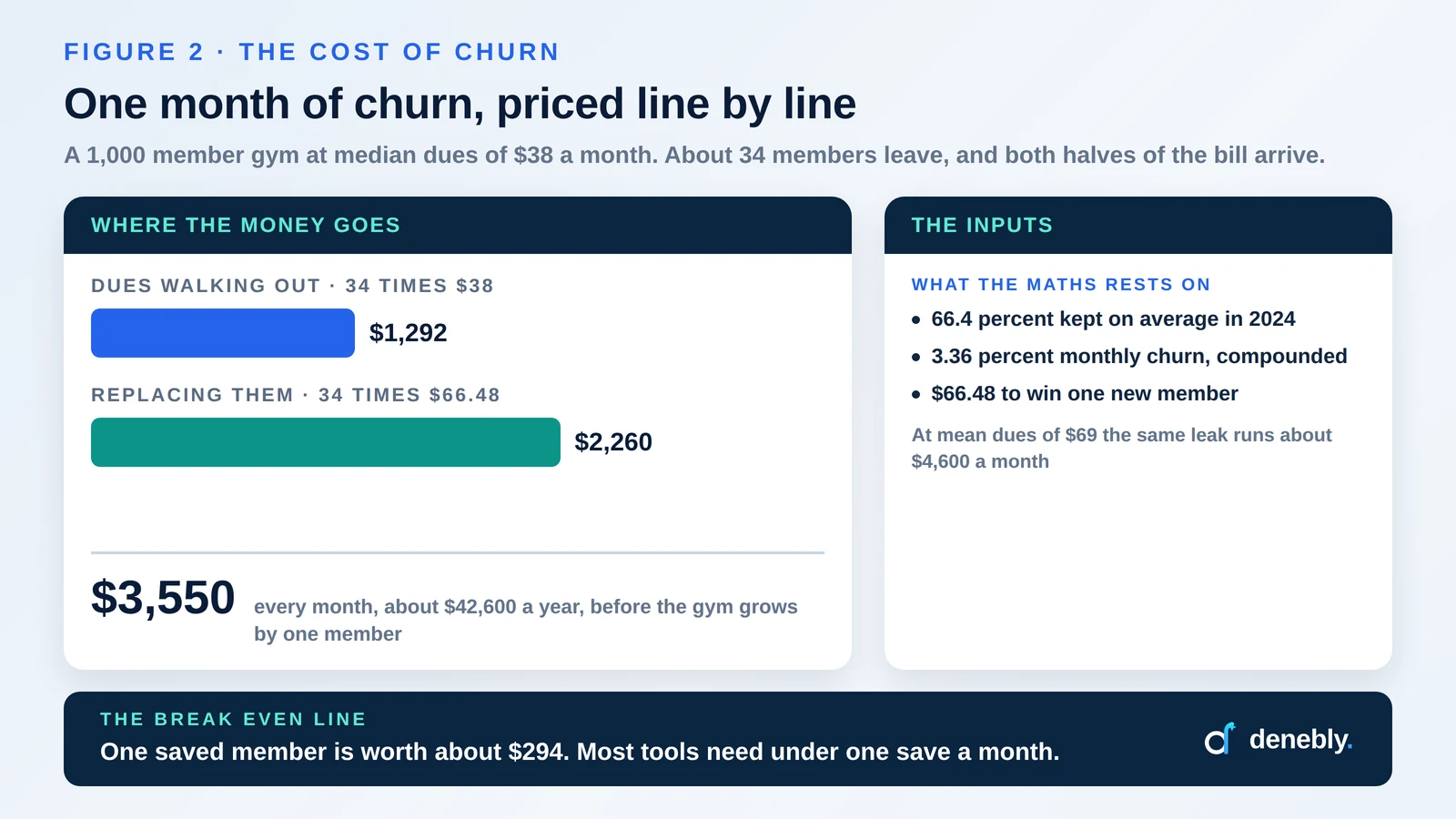
- The average club kept 66.4 percent of its members in 2024, on the Health and Fitness Association’s benchmarking. For a 1,000 member gym at median dues, churn costs about $3,550 a month before any growth.
- Every tool in this category does one job. It ranks your members by cancellation risk. Staff conversations do the saving.
- Most single gyms already own the tool, inside Glofox, Wodify, WellnessLiving, PushPress or Mindbody. The work is switching it on and staffing the list.
- Up to one in three cancellations are failed payments, on ABC Fitness’s research. That slice needs card retries, not prediction.
- No vendor publishes audited churn reduction. Test any tool for 60 days against your own baseline before you judge it.
None of this needs a data science team. It needs the attendance and billing data your platform already holds, shaped into a score your staff can act on. That shaping is the work our machine learning services cover for small businesses, turning records you already collect into predictions your team can use.
What churn is costing you, worked out in full
The benchmark to start from
Start with the industry average, not with a vendor brochure. The Health and Fitness Association’s 2025 Fitness Industry Benchmarking Report puts average annual member retention at 66.4 percent for 2024, drawn from 175 companies and more than 17,000 facilities. Read the other way, the average club loses a third of its members every year.
Older IHRSA figures show how wide the spread is. In the 2019 Profiles of Success, clubs retained 69.3 percent of members in 2018, with independent clubs at 75.8 percent and chains at 62.3 percent. Where your gym sits in that spread changes the maths below, so the worksheet near the end of this article lets you rerun every line with your own numbers.
Step 1, turn the annual figure into a monthly one
Retention compounds, so the monthly figure is not the annual one divided by 12. Monthly survival is 0.664 raised to the power of one twelfth, which works out at 0.9664. Monthly churn is 1 minus 0.9664, which is 3.36 percent.
An independent count lands in the same place. The One Million Strong analysis of member records counted 33.6 cancellations per 1,000 members per month, which is 3.36 percent stated the other way round. Two different routes, one number.
The mistake to avoid is the shortcut. Multiply 3.36 percent by 12 and you get a little over 40 percent, which overstates the annual loss by nearly 7 points. Every churn figure in a vendor deck deserves this same check before it is believed.
Step 2, count the members walking out
Take a gym with 1,000 members. The size is illustrative, chosen so the percentages are easy to rerun at your own size. At 3.36 percent monthly churn, that gym loses about 34 members a month, and the annual benchmark says 336 will be gone across the year if nothing changes.
Step 3, price the leak
Dues first. The Health and Fitness Association’s figures for 2024 put average monthly dues at a mean of $69 and a median of $38, as reported by Athletech News. The gap matters, because half the market pays less than $38, and any maths built on the mean flatters a budget club. This example uses the median.
At $38, the 34 members who leave take $1,292 of monthly dues with them. Replacing them is the second cost. The median sales and marketing cost of winning one new member was $66.48 in IHRSA’s Profiles of Success, so standing still costs another 34 times $66.48, which is $2,260 a month.
Add the two and churn costs this gym about $3,550 a month, roughly $42,600 a year, before it grows by a single member. At mean dues of $69 the same leak is about $4,600 a month, roughly $55,300 a year.
One more line for scale. At a steady 3.36 percent monthly churn, the expected lifetime of a membership is about 30 months, so one member is worth roughly $1,130 in lifetime dues at the median, and about $2,050 at the mean. That figure assumes the churn rate stays constant, which is exactly the assumption a working retention programme is trying to break.
Step 4, draw the break even line for any tool
A save has a cash value, and a deliberately conservative one is easy to set. A member saved who stays just six extra months pays 6 times $38, which is $228 in dues, and the gym avoids one $66.48 replacement. One save is worth about $294.
Divide any tool’s monthly price by $294 and you get the saves it must produce every month to pay for itself. On a 1,000 member base, one save a month is a churn fall of one tenth of a point, from 3.36 to 3.26 percent. A tool that truly cut churn by half a point would save about 5 members a month, worth roughly $1,470, which is more than every published price in this guide.
| Tool | Published price per month | Saves needed per month to break even |
|---|---|---|
| PushPress Pro | $159 | 0.54, about one save every two months |
| WellnessLiving Business | $199 | 0.68 |
| PushPress Max | $229 | 0.78 |
| Churn Buster Dunning | $269 | 0.9, judged on recovered failed payments rather than saves |
| PushPress Grow add-on | $329 | 1.1 |
| Keepme | Quote only | Your quote divided by $294. A $500 quote, a labelled hypothetical, would need about 1.7 |
Hold that table against one fact before you spend anything. No vendor named in this article publishes audited proof that its tool delivers even the one save a month, and the full case sits in the evidence section below.
The follow up is where most gyms lose the save, because the list lands on a Monday and nobody works it. Sequences that chase a missed visit or a failed card on their own are an automation build, and our AI automation services set up exactly that layer for small service businesses.
What these tools actually do
Strip the marketing away and every product in this category runs the same loop. Watch behaviour, score risk, hand a human a list. The differences that matter are which signals feed the score, how far ahead it looks, and what your team is expected to do with the names it produces.
The score and the signals
The inputs are unglamorous. Visit frequency and how recently the last visit was. Class bookings made and missed. Recorded workout results. Tenure. Payment history, including failed payments. App engagement, milestones and goal progress. A member drifting away shows up in these numbers weeks before the cancellation email arrives, which is the whole basis of the category.
The output is a score or a band per member. Keepme scores every member from 0 to 100 and bands them Green, Amber and Red. ABC Glofox sorts members into high, medium and low risk. The packaging differs, and the job it creates does not. Someone on your team gets a ranked list of names, most urgent first.
The mechanics are the same ones used to rank sales leads by their chance of converting, which our guide to the best AI lead scoring tools for real estate agents works through in a different trade. A score is only ever a sorting device. What happens after the sort decides the money.
Two windows, two kinds of save
Glofox forecasts who is likely to leave in the next 14 to 21 days, using more than 16 data points and a model the vendor says was trained on data from more than 41 million member profiles, per its support documentation. A window that short suits one kind of save, a phone call this week and a specific next visit booked on that call.
Keepme looks six months out. A window that long cannot be worked with phone calls alone. It points at slower fixes, a programme change, a membership restructure, a new class habit. Neither window is better. They create different work, and buying the long window while staffing for the short one is a quiet way to waste the subscription.
The ranked list is the product
Say it plainly, because every buying decision in this article hangs on it. The tool produces a ranked list. People produce the retention. The strongest measured result in the research behind this guide is not a software feature at all, and it is covered in the evidence section below. A tool that nobody acts on is a dashboard subscription, and the market is full of them.
Retention, engagement, churn rate and win back are four different jobs
Half the confusion in this market is vocabulary, and it costs money, because tools get bought for one job and judged on another. One page ranking for this very search is entirely about winning back people who already left, sold under the retention label. Separate the four terms before you compare any two products.
| Term | What it actually measures | The honest test |
|---|---|---|
| Member retention | The outcome, the share of members you keep over a set period | Your annual retention set against the HFA average of 66.4 percent |
| Member engagement | The behaviour, visits, bookings, app use and class attendance | Whether this month’s behaviour predicts next quarter’s cancellations |
| Churn rate | The inverse measure, cancellations divided by members at the start of the period | Monthly and annual figures converted by compounding, not by multiplying by 12 |
| Win back | A different job, recovering people who have already cancelled | Cost per returning member set against the $66.48 cost of a brand new one |
Two more terms travel with these. Attrition is the word HFA and IHRSA reports use for the same loss that churn measures, not a separate metric. Member lifetime value is retention expressed as money, your dues divided by your churn rate, which is why the roughly $1,130 figure in the cost section moves the moment your churn rate does.
The tools, type by type
Prices below were read on the vendors’ own pages in November 2026, unless a different checker is named inside the entry. Where a vendor publishes no price, the entry says so rather than borrowing a number from a listicle.
Dedicated prediction overlay, Keepme
Keepme is the specialist. Its Score runs from 0 to 100 for every member, banded Green, Amber and Red, and forecasts attrition risk six months out at the level of the individual member. The current platform, Antares, adds agents on top of the score, including Ember, an agent tasked with spotting members who start to drift and stepping in early. It layers onto the systems a gym already runs, with named connections to ABC Ignite, Mindbody, Glofox and Daxko, rather than replacing them.
The agent layer is worth understanding on its own terms, and our explainer on multi agent systems for business departments shows how a team of small agents divides a queue of work like this one.
Keepme reports 91 to 95 percent accuracy for that six month forecast. That figure is vendor reported and has not been independently audited, a caution the Rework buyer’s guide prints next to the number and this article repeats on purpose. Treat it as a claim to test inside your own 60 days, not as a result.
Pricing is the weakness for a small operator. Every Keepme plan is custom quoted by operator size, and there is no free trial. The fit follows from that. This is a multi site purchase, where one risk view across several clubs can carry the quoting conversation, and the break even formula in the cost section is how the quote should be judged.
Built into your platform, Glofox, Wodify and WellnessLiving
ABC Glofox builds the prediction into its Members at Risk report, sorting members into high, medium and low risk of leaving in the next 14 to 21 days, from more than 16 data points. Around it sit XLerate, a built in CRM running behaviour triggered SMS, email and push journeys, and automated payment recovery with configurable retries. Glofox publishes a starting price of $99 a month per location, and the tiers above it are quote based.
The tier trap and the waiting period are the catches. The report sits only on the Boost and Elite tiers. The vendor also states that a business must be live on Glofox for 3 months before the data compiles, and a member must be active for 3 months before they can be categorised. What that blind spot costs is covered in the evidence section.
Wodify Retain is the same idea inside Wodify. Its help centre describes a machine learning tool that flags at risk clients from attendance trends, recorded performance results, membership duration and last visit, trained on data across thousands of businesses. Flagged members carry a red ring on their profile and sit on a Retain list until staff reach out, and the at risk alerts sit on the Accelerate and Ultimate plans.
Wodify does not publish the price cleanly on its own site. Gymdesk’s buyer’s guide, checked against vendor sites on 2 October 2026, lists Wodify from $199 a month per location. Treat that as third party checked rather than vendor published, and confirm it before you budget around it.
WellnessLiving names its assistant Isaac, and its own pricing page lists a Client at risk Predictor that uses Isaac to predict when clients are at risk of leaving. The marketing layer around it carries win back sequences for lapsed clients, rewards and loyalty, and drip campaigns. Its prices are the most open in this category, Starter at $69 a month, Business at $199 and BusinessPro at $349, with Enterprise by quote.
Read the tiers before the headline price excites you. The retention marketing tools, campaigns and win back sequences, start at the Business tier. The $69 Starter tier carries transactional notifications only, so the cheapest version of this platform does not include the machinery this article is about.
Platform routes with published pricing, PushPress and Mindbody
PushPress takes a lighter route. Its AI Assistant, in the vendor’s own words on its pricing page, gives instant answers about members, attendance, leads, revenue, retention and more. Member Intel surfaces milestones and attendance patterns, and Committed Club tracks and rewards consistent attendance. The Grow add-on is the automation layer, a CRM with nurture and re-engagement sequences and two way SMS.
Every price is published and month to month, with no contracts. Core is free at $0, with card processing at 4.99 percent plus $0.30. Core Pro is $159 a month, Core Max is $229, the Grow add-on is $329, Train starts at $79 and the Branded App is $97. The honest weakness is depth. There is no individual churn score here of the Keepme kind, and the free tier records your data while the features that act on it sit on the paid tiers.
Mindbody, the largest name in this market, has the thinnest retention story of the group. Its AI piece is Messenger[ai], rebranded AI Concierge, a 24/7 assistant for booking, questions and missed calls, sold as an add-on on the Accelerate tier and included on Ultimate. Automated marketing campaigns sit on the Ultimate tier, and Mindbody publishes no equivalent of an individual churn score.
Its current US pricing page, updated 8 October 2026, publishes one number, Starter from $79 a month per location, with Accelerate and Ultimate quote only and add-ons and processing on top. Some third party guides still quote $99, which was the price earlier in 2026. The vendor’s own page is the one to trust, and it says $79.
The automation layer
Under every prediction sits a messaging layer, and some gyms buy it separately. Inside the platforms it appears as Glofox’s XLerate and PushPress’s Grow. Bought standalone, the names are ActiveCampaign, listed from $15 a month for its Starter tier in the SmbAI guide’s price table, and Klaviyo. Both vendors reprice often, so check the current tier before budgeting.
The limit is knowledge. Neither standalone tool knows anything about gyms. Your platform has to supply the attendance signal that triggers the sequence, which means the automation layer is only ever as good as the report feeding it. Bought alone, it sends beautifully timed messages about nothing.
Failed payment recovery, the unglamorous winner
Churn Buster does one job, recovering failed payments and running cancellation flows for subscription businesses. It is not gym software. It runs on billing platforms such as Stripe and Braintree, so it only fits a gym whose billing runs through a supported platform. Its Measure analytics plan is free, Dunning or Cancel Flows start at $269 a month, both together start at $430, and the fee is flat by revenue tier, month to month, with no commission on recovered revenue.
It earns its place in a retention guide on one number. ABC Fitness’s Wellness Watch research, cited by the Rework buyer’s guide, attributes up to one in three gym cancellations to failed payments. Most platforms also retry failed cards on their own schedules, and switching those retries on costs nothing. Fix this slice before you pay anyone to predict the rest.
Which route fits your gym
The right purchase depends on your member count and the platform you already run, not on which demo impressed you. Four situations cover most gyms reading this.
| Your situation | The route | What it rests on |
|---|---|---|
| Fewer than about 300 members | Work a manual at risk list from your platform’s attendance reports, and switch on payment retries | Models need history you do not yet generate, and on a small base the break even line is hard for any monthly fee to clear |
| One gym or boutique studio on Glofox, Wodify, WellnessLiving or PushPress | Use the built in feature on the tier that includes it, worked weekly by a named staff member | You already pay for the data. The missing piece is the weekly habit, not another platform |
| A gym on Mindbody | Fix campaigns and payment recovery first | The published product has no individual churn score, so the retention gains sit in follow up and billing |
| Several sites under one owner | Ask Keepme for a quote and judge it with the break even formula | One risk view across sites is the one thing the built in reports cannot give you |
Notice what is not in the table. There is no row where the answer is a second platform bought to watch the first one. Until the built in list is being worked every week, that purchase buys a more expensive way to ignore the same names.

The evidence against buying any of it
This is the section the vendors would skip, and it is the section that decides whether the rest of this article was worth reading. The case against this category is not that the tools are badly built. It is that the proof standard the whole market runs on would not survive any other purchasing decision you make.
No audited proof exists
There is no independent, peer reviewed or association published study measuring how much any AI retention tool reduces churn. Not a small one, not a contested one, none. Every effectiveness number in this market is a vendor claim, a vendor case story, or an inference borrowed from studies of human processes. One vendor customer story in this category reports no number at all. When a salesperson quotes you a churn reduction, the correct response is to ask for the audit, and to watch the conversation change.
The model is blind where churn is worst
Churn is front loaded. Gymdesk’s 2026 Benchmark, drawn from 4,594 gyms on its platform, found that nearly 1 in 5 new members quit within 90 days, after which cancellations settle at about 2 to 3.5 percent a month. Hold the sample caveat with the figure, because most of those gyms are martial arts schools. An academic study of 5,240 members by Sperandei, Vieira and Reis, published in 2016, points the same way, with 63 percent of tracked members gone before month three.
Now set that against the tools’ own conditions. Glofox needs 3 months of your business data and 3 months of a member’s activity before its model categorises anyone. The period where a fifth of your members leave is the period the model cannot see. Add the population problem. These models are trained on data from large operators, and Glofox cites more than 41 million profiles. A 300 member independent gym is a different population, with different reasons for leaving.
A third of the problem is billing wearing a retention costume
Up to one in three cancellations trace back to failed payments, per ABC Fitness’s Wellness Watch research. No prediction is required to fix an expired card. Alongside it sits the membership structure itself. In the One Million Strong analysis, monthly plan members cancelled at 42 per 1,000 per month against 10 per 1,000 for members on 12 month contracts. The contract on offer moves churn more than any software feature in this guide, and it is a pricing decision, not a purchase.
The strongest measured effects are human
Two results tower over everything the software claims, and both are processes. In IHRSA’s Member Retention Report, Volume 3, a successful commitment interaction, meaning staff getting an at risk member to commit to a specific future visit, cut next month cancellation odds by 45 percent against similar members who had no interaction.
Research by Dr Paul Bedford, cited in ABC Glofox’s own retention guide, found members who completed full onboarding were retained at 87 percent after six months against 60 percent without it, a figure that reaches us through a vendor page and should be weighted as such.
Underneath both sits behaviour. The Retention People study of 10,000 UK members, cited by IHRSA, found gym only members were 56 percent more likely to cancel than members who also took group exercise. A tool can flag the member who stopped booking classes. It cannot take the class with them, book them into the next one, or notice they looked miserable on Tuesday. That is the work, and it is staffed or it does not happen.
Retire one number before you go. The claim that keeping a member costs 5 times less than winning one is repeated across this market, and it traces to generic retention marketing material from outside fitness, with no fitness specific measurement behind it. The companion claim, that small retention gains lift profit by 25 to 95 percent, has the same problem. Both may be true in spirit. Neither is evidence, and neither belongs in a business case you sign.
How to test any tool in 60 days
Since no vendor will prove the effect for you, prove it yourself, on your own members, against a pass mark you set before the trial starts. Sixty days is enough for two full cycles of the weekly list and a fair read on saves.
Step 1, set your baseline
Pull your cancellations and your starting member count for each of the last 3 months and compute monthly churn for each one, cancellations divided by members at the start of the month. Average the three. This is the number the tool has to beat, measured your way, not the dashboard’s way.
Output. One baseline churn figure and the three monthly counts behind it, written down where the team can see it.
Step 2, write the pass mark before the trial starts
Use the break even line from the cost section. Divide the tool’s monthly price, or the tier upgrade it forces, by the value of one save at your dues. At median dues that value is about $294, so a $199 tier must produce 0.68 saves a month, which means a pass mark over 60 days of at least 2 counted saves your baseline says you would not have had. A pass mark invented after the results arrive is not a pass mark.
Output. A dated pass mark, in saves per 60 days, agreed before the first list is pulled.
Step 3, work the list weekly, the same way every week
Pull the at risk list on the same weekday. A named owner calls the top 10 names before any automated message goes out, aiming for the commitment interaction the research measured, one specific next visit agreed on the call. Offer a pause before a discount. Automated sequences then chase whoever the calls did not reach.
If the logging and follow up load grows past one person’s memory, that tracking work is where an assistant earns its keep, and our guide to an AI copilot for real estate agents shows the same staff plus assistant pattern running in another client business.
Output. Weekly lists across the trial, each with a named owner and every top 10 name called.
Step 4, log every outreach and its result
For every name, record the outreach, the response, and the outcome 30 days later, saved, paused or cancelled. Without this log you have anecdotes, and the vendor’s dashboard will happily supply its own version of events, measured in scores improved rather than members kept.
Output. One log line per name, with the 30 day outcome filled in.
Step 5, judge on day 60, on saves alone
Compare counted saves against the pass mark, and against your baseline churn across the same two months. Renew only if the saves clear the break even line with room to spare. Cancel, or drop back to the built in feature, if the evidence is a prettier dashboard and the same cancellation count.
Output. A renew or cancel decision with the save count attached to it.
If your 60 day test shows the built in score is too blunt for your members, the next step is a model trained on your own attendance and billing history rather than a national average. That is a scoped build, and it is the kind of work our machine learning team scopes with you before a line of code is written.
The rule to keep
Buy the list only if someone is paid to work the list. Fix failed payments before you buy prediction, because a third of the leak needs no model at all. And measure every tool in saves you can count, never in scores it reports about itself.
If you would rather have the scoring, the follow up sequences and the reporting built around the platform and the data you already run, let’s discuss your project. Write to sales@denebly.com or call +1 (214) 896-2906, and the first reply will come from the people who would do the work, with an honest view on whether a build beats the built in feature you already own.
Your churn worksheet and 30 day save checklist
Two things to copy. The first reruns this article’s maths on your own numbers. The second turns the evidence into four Mondays of work.
The churn cost worksheet
| Line | Your number | How to get it |
|---|---|---|
| Members today | ___ | Your platform’s active member count this morning |
| Your average monthly dues | ___ | What a typical member actually pays, not the rack rate |
| Cancellations last month | ___ | Count them all, including failed payment cancellations |
| Your monthly churn rate | ___ | Cancellations divided by members at the start of last month |
| Members leaving each month | ___ | Members today multiplied by your churn rate |
| Dues leaving each month | ___ | Members leaving multiplied by your dues |
| Your cost to win one new member | ___ | Last quarter’s sales and marketing spend divided by new members won |
| Money spent standing still each month | ___ | Dues leaving, plus members leaving multiplied by your cost to win one member |
| Your tool quote per month | ___ | The subscription price, or the tier upgrade the feature forces |
| Value of one save | ___ | Six times your dues, plus your cost to win one member |
| Saves the tool must produce each month | ___ | Your tool quote divided by the value of one save |
The 30 day at risk save checklist
- Every Monday, pull the at risk list and rank it before anything else is done that day.
- Call the top 10 names personally before any automated message is sent to them.
- On each call, aim for one commitment to a specific next visit, the interaction IHRSA measured at 45 percent lower cancellation odds.
- Offer a pause before you offer a discount, and note which one each member took.
- Log every outcome the same day, saved, paused or cancelled.
- Send the automated sequence only to the names the calls did not reach.
- On day 30, count the saves and set the count against your break even line from the worksheet.
- Repeat the month with the list worked the same way, or stop and spend the fee elsewhere.
Questions gym owners ask
What is a good gym retention rate?
The industry average is the honest yardstick. The Health and Fitness Association’s 2025 Benchmarking Report puts average annual retention at 66.4 percent for 2024. Older IHRSA figures show a wide spread, with independent clubs at 75.8 percent and chains at 62.3 percent in 2018, so a single site keeping three quarters of its members is already beating the market.
How do you calculate gym churn rate?
Divide the members who cancelled in the month by the members you had at the start of it. Convert an annual retention figure by compounding, not by dividing by 12. Annual retention of 66.4 percent works out to monthly churn of about 3.36 percent, and 3.36 percent a month compounds back to 33.6 percent a year, not 40 percent.
Can AI really predict which gym members will cancel?
It ranks risk, it does not read minds. The models score members on visit patterns, bookings, tenure and payment history, and the ranking is useful because drifting members really do visit less before they leave. What no vendor offers is audited proof of accuracy. Keepme’s 91 to 95 percent figure, for example, is vendor reported and not independently audited.
How far ahead can a tool see a cancellation coming?
It depends on the model. ABC Glofox flags risk 14 to 21 days out, which suits a phone call and a booked next visit. Keepme forecasts six months of attrition risk, which suits slower fixes such as a programme change or a membership restructure. The window decides what kind of save is even possible.
How much does gym retention software cost?
Published prices in November 2026 run from WellnessLiving Starter at $69 a month, where the retention marketing tools are not included, through PushPress Pro at $159 and Max at $229, to the PushPress Grow automation add-on at $329. Churn Buster’s recovery plans start at $269. Keepme and the higher Glofox tiers are quote only.
Is a built in platform feature enough, or do you need a dedicated tool like Keepme?
For one gym, the built in feature is enough in almost every case, provided your tier includes it and a named staff member works the list weekly. A dedicated overlay earns its quote when you run several sites and need one risk view across all of them.
What should staff actually do with an at risk list?
Call the top names before any automated message goes out, and aim for one thing, a commitment to a specific next visit. IHRSA’s Member Retention Report, Volume 3, found that a successful commitment interaction cut next month cancellation odds by 45 percent. Offer a pause before you offer a discount, and log every outcome so the list gets smarter.
Do retention tools work for a small gym with under 500 members?
The prediction is at its weakest there. The models are trained on large operator data, and Glofox needs three months of your history and three months of member activity before it categorises anyone. Under 500 members, start with a manual at risk list from attendance reports and switch on payment retries. Buy prediction when the list gets too long to work by hand.
How much of gym churn is just failed payments?
Up to one in three cancellations, according to ABC Fitness Wellness Watch research cited by the Rework buyer’s guide. That slice needs no prediction at all. Card retries, pre-expiry reminders and a recovery sequence fix it, which is why payment recovery comes before prediction in this article’s order.
What is the difference between member retention and member engagement?
Retention is the outcome, the share of members you keep. Engagement is the behaviour, visits, bookings and app use. Engagement is what the models watch, and it is a warning light, not the result. A member can train four times a week and still cancel over price.
Sources
- Health and Fitness Association, 2025 Fitness Industry Benchmarking Report. The source of the 66.4 percent average annual retention figure for 2024, from 175 companies and more than 17,000 facilities. The 2024 dues figures used in the cost section, a mean of $69 and a median of $38, are HFA figures as reported by Athletech News.
- IHRSA, 2019 Profiles of Success. The 2018 retention figures, 69.3 percent overall, 75.8 percent for independent clubs and 62.3 percent for chains, and the $66.48 median cost of acquiring one member, as cited by Gympse.
- IHRSA, Member Retention Report, Volume 3. The commitment interaction result, a 45 percent cut in next month cancellation odds after a successful commitment interaction, as cited by Gympse.
- One Million Strong member records analysis. The count of 33.6 cancellations per 1,000 members per month and the contract effect, 42 per 1,000 on monthly plans against 10 per 1,000 on contracts, as compiled by Regymo.
- Gymdesk, 2026 Benchmark. The finding that nearly 1 in 5 new members quit within 90 days, drawn from 4,594 gyms on the Gymdesk platform, most of them martial arts schools.
- ABC Fitness, Wellness Watch research. The finding that failed payments drive up to one in three cancellations, as cited in the Rework buyer’s guide.
- The Retention People. The study of 10,000 UK members behind the group exercise finding, cited by IHRSA.
- Sperandei, Vieira and Reis, 2016. The academic study of 5,240 members in which 63 percent of tracked members had abandoned before month three.
- Vendor pages and documentation, read in November 2026. Keepme, ABC Glofox and its support documentation, the Wodify help centre, WellnessLiving, PushPress, Mindbody and Churn Buster, for every feature, tier condition and price stated in the catalogue. Gymdesk’s buyer’s guide, checked against vendor sites on 2 October 2026, is the checker named where a vendor does not publish its own price.
Following this site’s external link rule, vendors are cited here as the sources of their own product facts but are not linked. Prices and tier conditions move, so verify the figure that decides your purchase on the vendor’s current page before you sign anything.

WRITTEN BY
Arslan Mushtaq
Founder, Denebly
Arslan founded Denebly in 2018 and leads its AI development work for startups and mid-size businesses, across AI chatbots, agentic workflows, RAG systems, machine learning and automation. Denebly has delivered 100+ projects from Dallas, Texas.
Ready to Solve Your Business Problems With AI?
Tell us what you are trying to build, automate or fix. You will get an honest assessment within one business day, not a sales pitch.