Insights
Best AI Receptionist for Small Business: 9 Tools Compared on Price and Booking

Every small business owner knows the sound: the phone ringing while both hands are busy with a customer. Most of those callers leave no message. They call the next business on the list. Picking the best ai receptionist for small business fixes that leak, but only if you pick on the right facts: what it costs at your real call volume, and whether it can book the job while the caller is still on the line.
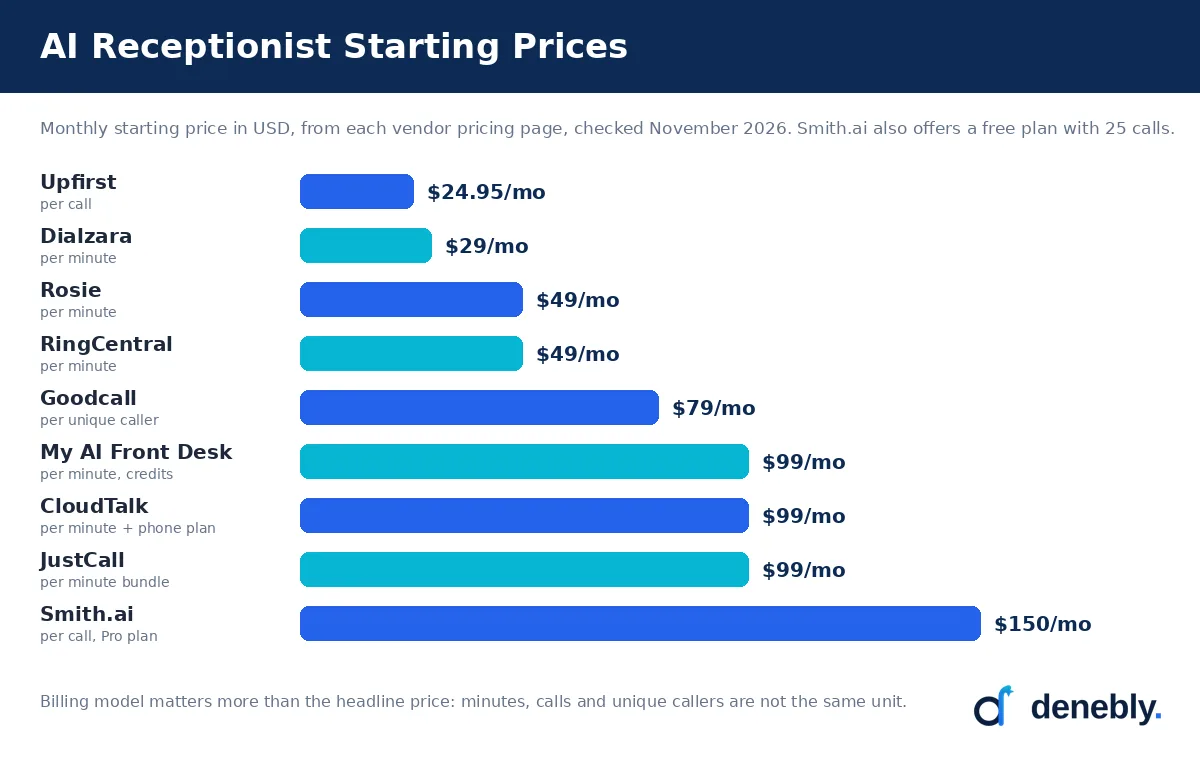
The best ai receptionist for small business is the one whose billing model matches your call pattern and that books into your real calendar on the plan you can afford. Entry prices run from $24.95 to $150 a month across the nine tools below, and the cheapest headline price is often not the cheapest bill.
Key takeaways:
- Billing model beats headline price: the same month of calls costs far more on the wrong model.
- Booking is not included everywhere. On some entry plans the AI only takes messages; booking starts one tier up.
- Two of the nine prices are add ons needing a phone plan or seat plan underneath.
- A free test exists: Smith.ai offers a free plan with 25 calls a month; most others offer a trial.
Not sure which model fits your call pattern? Start with our AI readiness audit, or let’s discuss your project.
What an AI Receptionist Does, and What Best Really Means
An AI receptionist is a voice AI agent that answers your business phone in your name. It greets the caller, answers questions from your own information, books appointments, captures lead details, takes messages, and transfers urgent calls, around the clock. For the full explainer on how the service works and what it costs, read our guide to AI virtual receptionist services first.
Best does not mean the longest feature list. The best ai receptionist for small business does four jobs well: answers on the first ring, books into the calendar your team already uses, hands urgent calls to a person fast, and keeps its bill predictable in your busiest month.
The 9 Tools, Compared
Monthly starting prices in US dollars, from each vendor’s pricing page, checked November 2026. Booking strength: Strong means it books into your real calendar on the entry plan, Gated means booking starts higher, Bundle means the price sits inside a wider system.
| Tool | Type | Billing model | Verified starting price | Booking strength |
|---|---|---|---|---|
| Upfirst | AI first | Per call | $24.95 for 30 calls | Strong |
| Dialzara | AI first | Per minute | $29 for 60 minutes | Strong |
| Rosie | AI first | Per minute | $49 for 250 minutes | Gated (from $149) |
| RingCentral AI Receptionist | Phone system AI | Per minute | $49 for 100 minutes, standalone | Strong |
| Goodcall | AI first | Per unique caller | $79 for 100 unique callers | Strong |
| My AI Front Desk | AI front office bundle | Per minute, credits | $99 for 200 minutes | Bundle |
| CloudTalk | Phone system with AI | Per minute plus phone plan | $99 for 200 minutes, plus plan from $25 per user | Bundle |
| JustCall | Phone system with AI | Per minute bundle | $99 for 100 minutes, plus a seat plan | Bundle |
| Smith.ai | AI with human backup | Per call | Free for 25 calls, Pro from $150 for 75 calls | Strong + human backup |
On price alone, Upfirst at $24.95 looks like the best ai receptionist for small business, but 30 calls is a small allowance. Compare your own month against each model instead, as the cost section does.
The 9 Tools in Detail
1. Upfirst: the lowest entry price
Upfirst bills per call, which suits short, simple calls. Starter is $24.95 a month for 30 calls, extra calls $1.50 each; Premium is $59.95 for 90. Every plan includes the full feature set, including calendar integrations and call transfers, per its help center; spam calls never count. Best for: a solo owner who wants booking from day one.
2. Dialzara: low price, booking included
Dialzara bills per minute. Business Lite is $29 a month for 60 minutes, overage $0.48 a minute; Business Pro is $99 for 220 minutes. Booking and transfers come with the entry plan, rare at this price. Best for: phone first businesses that will watch their minutes.
3. Rosie: great minutes, gated booking
Rosie’s bundles are generous: Professional is $49 a month for 250 minutes, Scale is $149 for 1,000, Growth is $299 for 2,000. But on the entry plan Rosie only answers and takes messages; in call booking and live transfers start on the $149 Scale plan.
4. RingCentral AI Receptionist: best inside RingCentral
RingCentral sells its AI Receptionist two ways: $49 a month standalone with 100 minutes, or $39 a month as a RingEX add on, overage $0.50 a minute in 30 second steps. It books into Google Calendar and Outlook natively. Best for: teams already on RingCentral.
5. Goodcall: the predictable bill
Goodcall bills per unique caller, not per minute or per call. Starter is $79 a month for 100 unique customers, then $0.79 each; Growth is $129 for 500 and Scale is $299 for 2,000, minutes unlimited. One loyal customer who calls ten times counts once, so repeat callers get a flat bill. Best for: local services with repeat callers and long calls.
6. My AI Front Desk: the front office bundle
Now branded Frontdesk, My AI Front Desk sells one plan that answers phone calls: Business-in-a-Box at $99 a month, or $79 billed annually, with 200 voice minutes. Extra minutes cost $0.25 each via credits. The price also covers web chat, two way SMS, a built in CRM and automations, and it books into live calendars. Best for: growing businesses wanting phone, chat and text in one bundle.
7. CloudTalk: AI inside a full phone system
CloudTalk’s AI Receptionist is $99 a month for 200 minutes, overage $0.50 a minute, first 50 minutes free. It books during the call and logs to your CRM. The honest catch: that $99 is an add on. A phone plan from $25 per user per month sits underneath it, so one person pays at least $124 a month all in. Best for: teams replacing their phone system and adding AI together.
8. JustCall: strong agent, seat plan underneath
JustCall’s AI Voice Agent answers, qualifies callers, books meetings, sends follow up texts and syncs to your CRM. Its official guide prices it at $99 a month for 100 minutes or $249 for 300, or $0.99 a minute pay as you go. Like CloudTalk, it sits on a base plan you also pay per user for. Best for: sales and service teams that live in their CRM.
9. Smith.ai: AI with a human safety net
Smith.ai is the only tool here with real receptionists behind the AI. Its AI free plan covers 25 calls a month, then $3.00 per extra call; Pro starts at $150 for 75 calls, and live agent help can be added for hard calls. A busy month costs real money per call, but no call dead ends with a bot. Best for: law firms and professional services where one mishandled call costs more than the plan.
What One Real Month Costs on Each Billing Model
Headline prices cannot be compared directly, because the units differ. This is where most buyers pick the wrong best ai receptionist for small business: they compare entry prices, not their own month. One sample month: 100 calls, 300 minutes, 60 callers.
- Per minute plans: 300 minutes fits inside Rosie Scale at $149. On Dialzara Lite it costs $29 plus 240 extra minutes at $0.48, about $144.
- Per call plans: 100 calls on Upfirst means Premium at $59.95 for 90 calls plus 10 extra, about $75. On Smith.ai, 100 AI calls land at about $150 on Pro.
- Per unique caller: 60 different callers fit inside Goodcall Starter at $79 flat, however long the calls run.
The same month lands between about $75 and $150 depending on the model, which is why the model matters more than the entry price. In the builds I scope at Denebly, this one month test runs first. For the human benchmark, the US Bureau of Labor Statistics puts median receptionist pay at $38,010 a year.
Seen your number in that range? Let’s discuss your project: tell us your call volume and we will tell you honestly which model fits, even if the answer is a $29 tool.
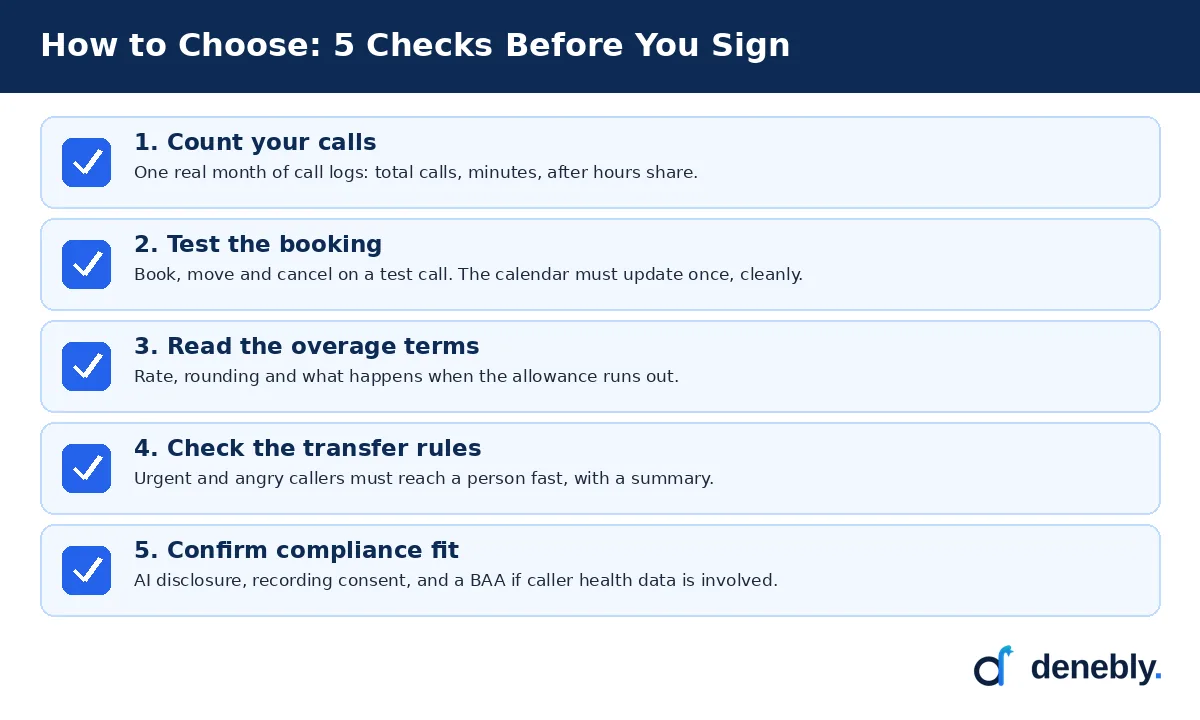
How to Choose: Run These 5 Checks
- Count your calls. Pull one real month of call logs: total calls, total minutes, how many different callers, and how many land after hours. Every price decision gets easy after this.
- Test the booking. On a trial, book a job, then move it, then cancel it. Pass: the calendar updates once, cleanly, with a confirmation sent. Fail: a booking link by text while the page promised real booking.
- Read the overage terms. Rate, rounding, and what happens when the allowance runs out.
- Check the transfer rules. Call with an urgent problem and with a complaint. A person should take over fast, summary in hand.
- Confirm the compliance fit. The greeting should disclose the AI, recording consent must be handled, and if callers share health details, the vendor must sign a BAA. The FCC treats AI generated voices as artificial voices under the TCPA; read its guidance on AI voice calls first.
Run those five checks and the winner usually picks itself.
Booking Strength: The Feature That Decides
Answering is table stakes. Booking is where they split, and booking is the whole point: a call ending in a message is a lead you still have to chase, while a call ending in a calendar slot is work already won. When I review a setup before launch, the booking path is the first thing I test.
Three booking levels show up in this market. Real booking writes the appointment into your calendar during the call and sends the confirmation. Gated booking does the same only from a higher plan, as with Rosie below $149. Denebly builds this booking first pattern into its conversational AI assistants: the agent checks the live calendar before offering any time slot.
Three Traps That Make the Cheap Plan Expensive
Three traps make the cheap plan expensive when you shop for the best ai receptionist for small business. First, the gated feature trap: booking, transfers, the CRM sync or a second language sits one tier up. Price the tier you need, not the tier in the ad. Second, the add on trap: a $99 AI price needing a $25 per user phone plan under it is a $124 starting bill. Third, the unit trap: per minute looks cheap until callers get chatty; per call looks simple until wrong numbers inflate your count; per caller is wasted where nobody calls twice. One quieter check: ask whether the agent will refuse to share details it should not share, however a caller phrases the request.
When a Rented Tool Is Not Enough
Some businesses outgrow every tool on this list. The signs: intake steps no template offers, write back into a practice or field service system, several locations with different rules, or callers moving between phone and chat expecting one memory. Developer platforms exist for teams who build this themselves, billing per minute on top of the parts you assemble.
The other route is a managed build. Denebly, founded in 2018, has delivered 100+ projects across 8 years, and builds custom AI receptionists trained on your knowledge base, connected to your calendar and CRM, and tested on your real call scenarios before launch, price agreed in writing. The same process covers our AI chatbot development work for written channels.
If that sounds like your situation, let’s discuss your project. Bring your busiest month’s call pattern, and we will tell you honestly if a rented tool would do the job for less. Or start from our contact page instead.
Frequently Asked Questions
What is the best ai receptionist for small business overall?
There is no single winner. For most small businesses, Goodcall is the safest all round pick: per unique caller pricing keeps the bill flat and booking comes with the entry plan. Solo owners should start with Upfirst or Dialzara; firms that cannot risk a mishandled call, with Smith.ai.
How much does an AI receptionist cost per month?
Verified entry prices here run from $24.95 a month (Upfirst, 30 calls) to $150 a month (Smith.ai Pro, 75 calls). Most small businesses land between $49 and $99 a month, before any base plan an add on tool needs.
Can an AI receptionist really book appointments?
Yes, but not on every plan. Upfirst, Dialzara, Goodcall and Smith.ai book into your calendar from their entry plans. Rosie adds in call booking from its $149 Scale plan; below that it takes messages and shares booking links. Always run a book, move and cancel test call first.
Which billing model is cheapest: per minute, per call, or per caller?
Per caller wins when the same customers call often and talk long. Per call wins when calls are short and few. Per minute wins when volume is high but calls stay brief. Price your own last month on all three models first; the worked example here shows one month at $75 to $150.
Will callers know they are talking to an AI?
They should, and good setups tell them in the greeting. Callers accept an AI when it answers fast, gets the facts right and can reach a person on request.
Can I keep my existing business number?
Yes. Most setups forward your current number to the AI line, all day or only after hours and when your team is busy.
What happens when the AI cannot answer a question?
A good setup follows your transfer rules: it passes the call to a named person or takes a structured message with a transcript and summary for callback. The agent should never invent an answer. If a tool cannot show its fallback path in the trial, that is a fail.
Should I rent a tool or build a custom AI receptionist?
Rent when your calls are simple: hours, prices, standard bookings. Build when intake rules are custom or the agent must write into your main system.
Conclusion
The best ai receptionist for small business is not the cheapest name on a list. It is the tool whose unit matches your call log, that books into your real calendar on the plan you are actually buying, and that hands hard calls to a person without a fight. Run the five checks, price one real month on each model, and the choice is simple.
Let’s discuss your project. Denebly builds custom AI receptionists for small businesses from Dallas, Texas, price agreed in writing before work starts. Write to sales@denebly.com or call +1 (214) 896-2906, and bring your call volume: we will tell you plainly whether a rented tool or a build fits you better.

WRITTEN BY
Arslan Mushtaq
Founder, Denebly
Arslan founded Denebly in 2018 and leads its AI development work for startups and mid-size businesses, across AI chatbots, agentic workflows, RAG systems, machine learning and automation. Denebly has delivered 100+ projects from Dallas, Texas.
Ready to Solve Your Business Problems With AI?
Tell us what you are trying to build, automate or fix. You will get an honest assessment within one business day, not a sales pitch.