What Would Be an Appropriate Task for Using Generative AI
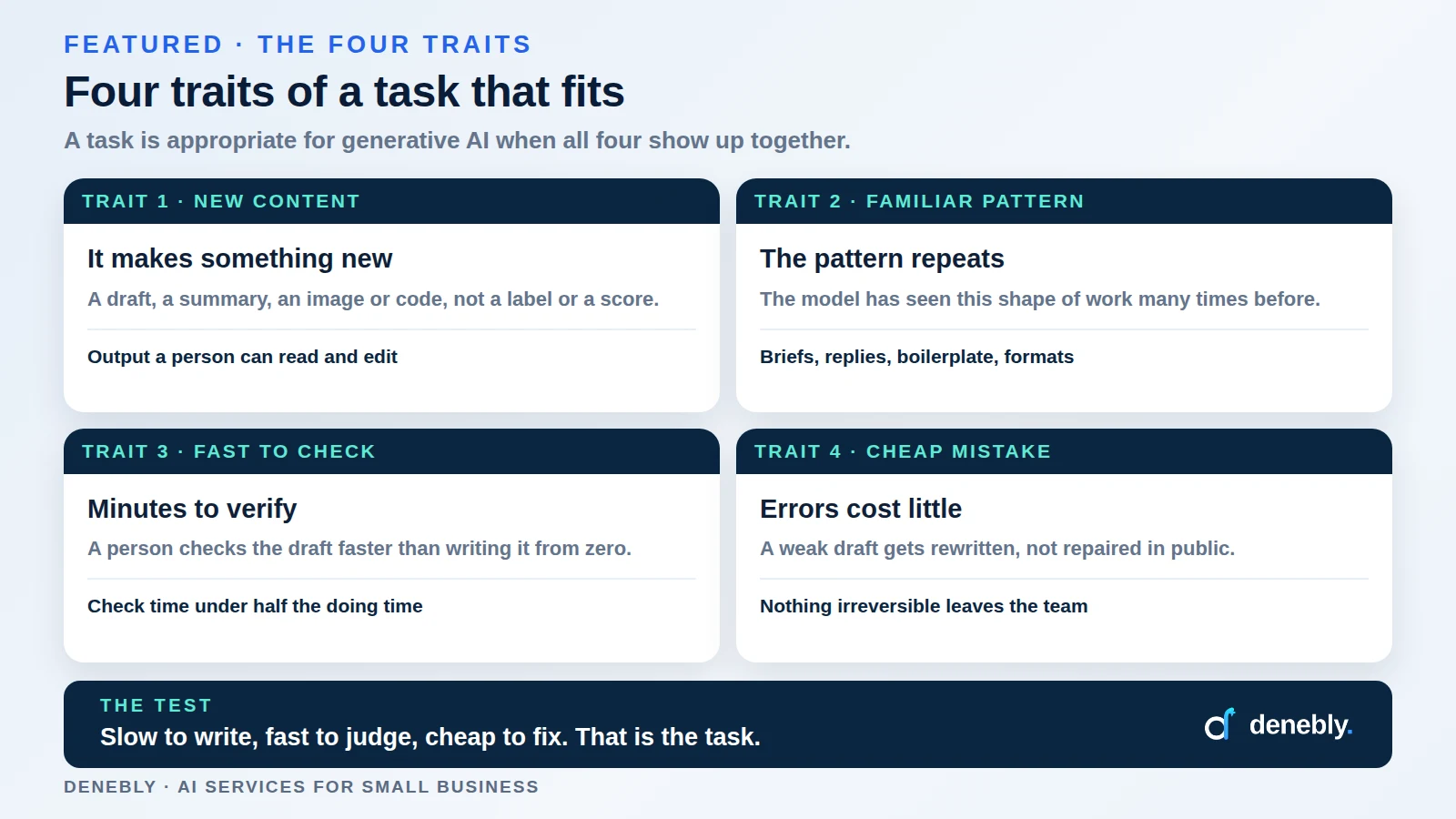
A ten person studio runs every client brief through a chat tool and saves an hour a day on summaries. Then someone pastes a refund decision, and the model writes a confident answer nobody checked. Same tool, same team. The difference is the task, never the tool.
What would be an appropriate task for using generative ai. Any task where the model produces a first draft a person can check in minutes, slow to start and fast to review, with a mistake cheap or reversible and a named person keeping the final call. Summaries and brainstorms pass. Final decisions do not.
If you want that judgement built into your tools, our generative AI services team designs the workflow and the approval steps with you.
The quiz answer, and why the summary wins
Training quizzes ask what an appropriate task for using generative ai would be, offering four options, and the correct answer is creating a brief executive summary of a business report. A reader can check the summary against the original document in minutes.
The wrong options share one flaw. They describe a final decision in law, money or health, where an error reaches a real person before anyone checks it. That contrast decides every example that follows.
What makes a task appropriate for generative AI
A task fits generative AI when it carries four traits. It produces new content rather than a label. It follows a pattern the model has seen many times. A person can verify the result quickly, and a mistake costs little to fix.
Generative AI creates new text, images, code or audio from patterns in its training data. It writes fluently and never checks its own work. Writing a first draft is slow, judging one is fast, so the model takes the slow half and leaves the fast half to the owner.
Noy and Zhang, in a 2023 Science experiment with 453 professionals, found ChatGPT cut writing time by 40 percent, with quality rated 18 percent higher. Brynjolfsson, Li and Raymond tracked 5,179 support agents and found 14 percent more issues resolved an hour, 34 percent for newer staff.
A Harvard Business School study of 758 consultants found 12.2 percent more tasks done and work 25.1 percent faster inside the frontier, and 19 percent less accuracy outside it. The tool that speeds up fitting work makes people worse at unfitting work, so task choice decides the outcome.
The main goal of generative AI, and the role data plays
The main goal of generative AI is to produce new content that resembles what the model learned from. Text tools such as ChatGPT and Claude write prose and code. Image tools such as DALL-E, Midjourney and Stable Diffusion turn a prompt into a picture. Music and video tools do the same.
Inside a business the goal lands in four places, content creation, visual design, business documentation and customer engagement through chat. In each one the model aims at plausible output, not verified output, and accuracy stays with the reviewer.
Data decides what a model can produce and which errors it repeats. Training data gaps become output gaps. Grounding data, your documents supplied at the moment of use, ties answers to your facts. Synthetic data expands small test sets. Lewis and colleagues set out the grounding method, retrieval augmented generation, in 2020. A task backed by your own documents is the safer task for generative AI.
Three questions to ask before you hand over a task
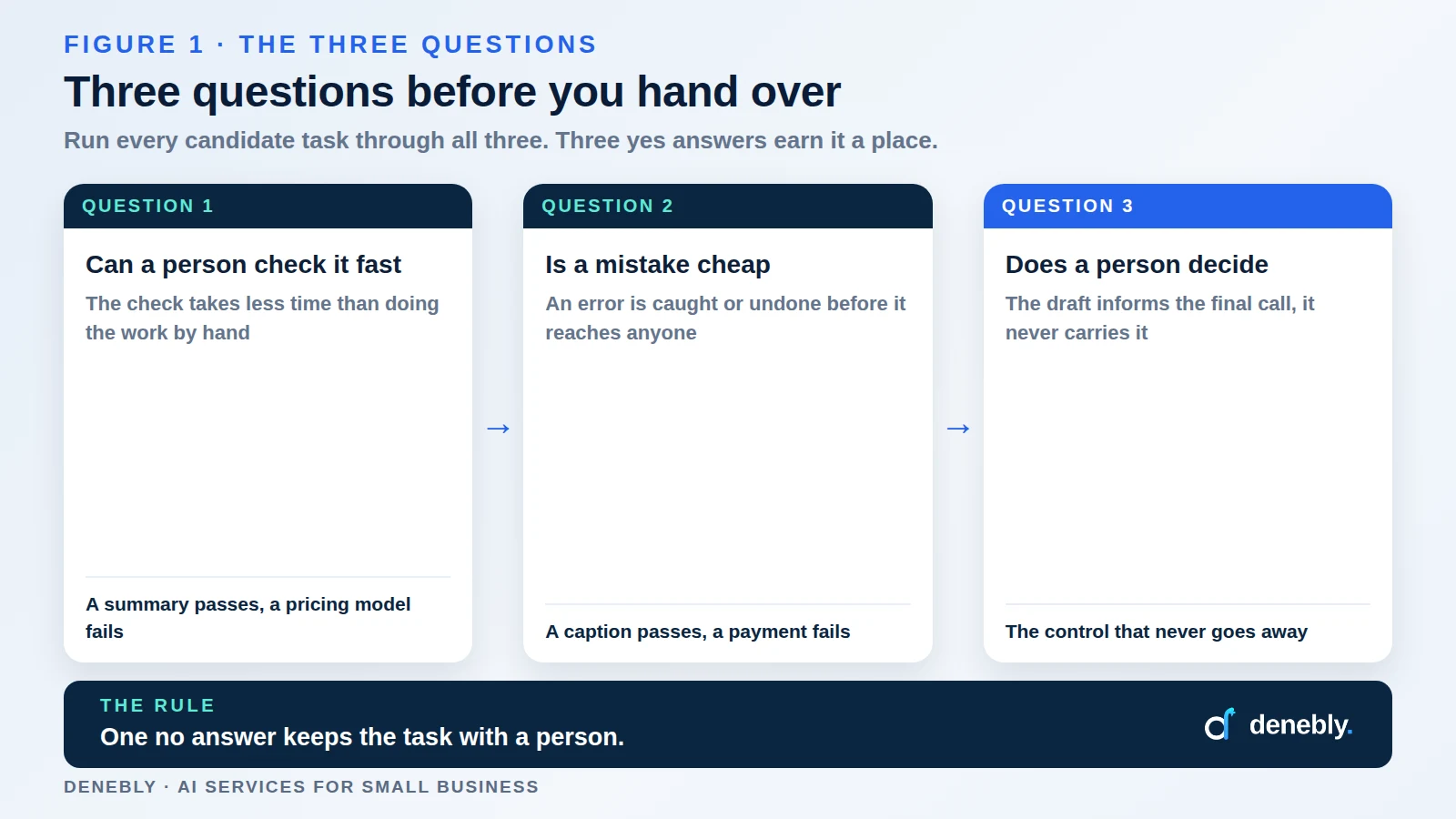
Before any tool opens, ask what an appropriate task for using generative ai would be in this job, then run the job through three questions. Three yes answers earn it a place.
- Can a person check the output faster than producing it. A meeting summary checked against the transcript passes. A pricing model you would have to rebuild before trusting it does not.
- Is a mistake cheap or reversible. A weak caption costs two minutes to rewrite. A sent payment, a filed form or a published health claim cannot be taken back.
- Does a named person make the final call. The draft informs the decision. It never carries it.
Seven tasks for generative AI that pass the test
Seven tasks for generative AI pass the three questions in almost every small business. Each carries a worked use and the check that keeps it honest.
Summarizing documents
Meeting transcripts, long email threads and customer reviews compress into a brief. A six person agency turns a one hour call into a one page brief of decisions and owners in about four minutes. The check that never goes away is the dropped point, so scan the brief against the decisions made.
Drafting first versions
Product descriptions, job posts and proposal drafts start faster from a model draft than from a blank page. The writer adds the facts the model cannot know. Treat a fresh draft as raw material. New claims carry a higher invention risk than a summary.
Brainstorming and outlining
Ask for twenty subject lines or ten campaign angles, then keep the two that work. Quantity is the point. Picking the best was always the human job, so the model only removes the slow part.
Code boilerplate and cleanup
API handlers, test scaffolding and SQL queries follow documented patterns a model writes well. Peng and colleagues measured developers with an AI pair programmer finishing a set coding task 55.8 percent faster. Review generated code like junior developer work, and run the tests before anything merges.
Formatting, cleaning and extracting data
Dates, amounts and names come out of unstructured emails into usable fields. Extraction keeps error rates low because the source sits beside the output. Spot check one record in ten.
Translating and localizing text
Internal documents and product copy translate fast. A fluent speaker reviews anything a customer will read, because idiom and brand voice need human judgement. Low risk internal work runs with a lighter check.
Personalizing customer messages
A support assistant drafts a reply from the order history and help articles, and an agent edits and sends it. Any message promising a refund, a discount or a legal outcome still waits for approval.
A worked example, one week of tasks at a six person company
Take a six person services company and score its real week. The week holds both kinds of work, tasks for generative AI and tasks that stay human. Replace the stated times with your own before deciding.
| Task, weekly volume | By hand | Draft plus check | Saved | The call |
|---|---|---|---|---|
| Support replies, 60 | 12 hours | 5 hours | 7 hours | Hand it over |
| Meeting notes, 5 | 2.5 hours | 50 minutes | 1 hour 40 minutes | Hand it over |
| Invoice fields, 20 | 2 hours | 40 minutes | 1 hour 20 minutes | Hand it over |
| Proposal first drafts, 1 | 3 hours | 1 hour 30 minutes | 1 hour 30 minutes | Draft only, person prices |
Sixty replies at twelve minutes each is twelve hours, and a drafted reply with a five minute check is five hours. At a loaded cost of 30 dollars an hour, the seven saved hours are worth about 210 dollars a week, near 900 dollars a month.
The refund decision letter never entered the table. It fails questions two and three, so it stays with a person however slow it feels. When a passing row repeats all day, our AI automation services team wires it into the inbox it touches, so the draft arrives on its own.
The task scorecard, copy it and score your own list
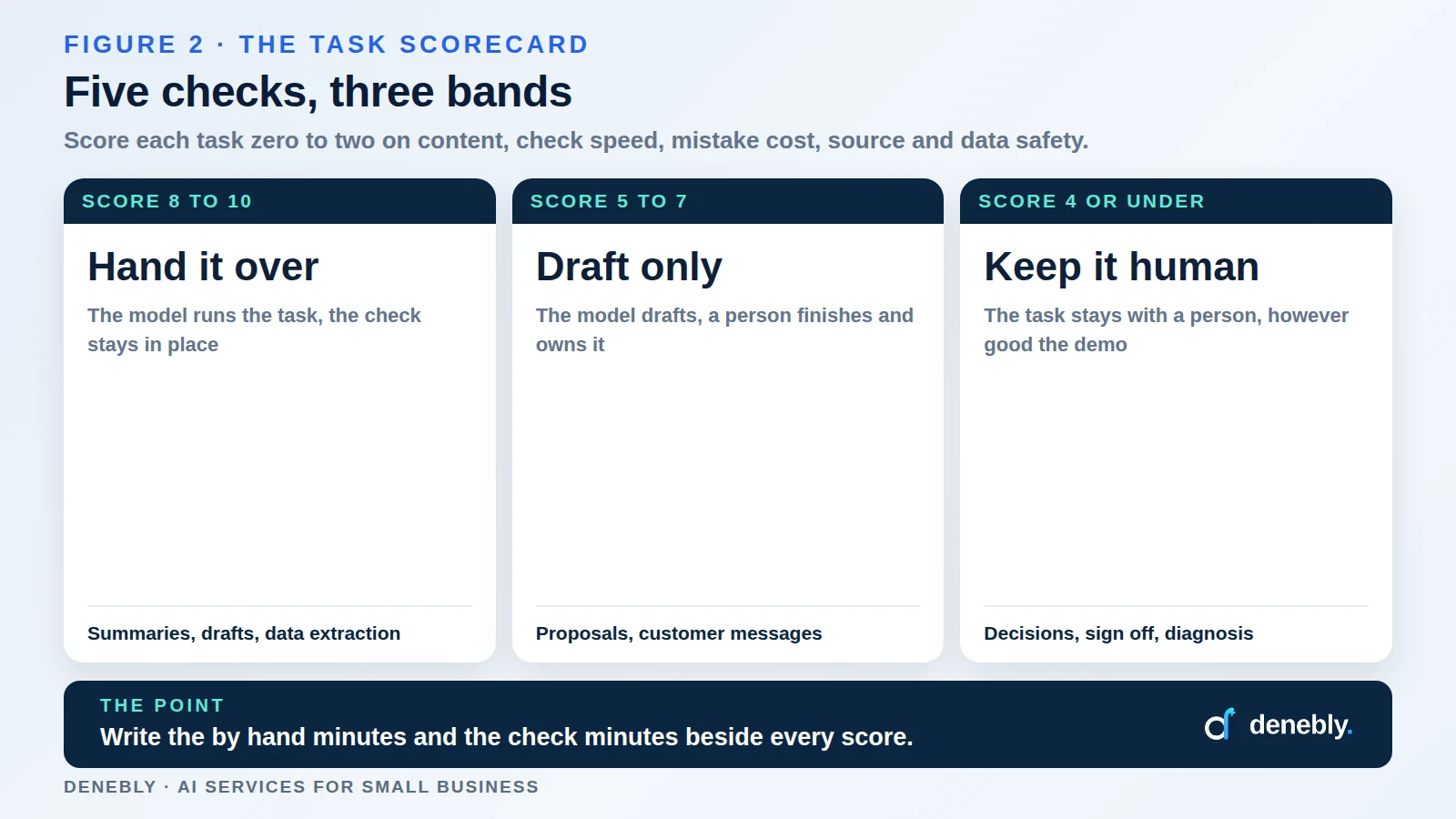
Score each candidate on five checks, zero, one or two points each. Write the by hand minutes and the check minutes beside the task, because scores mean little without the times.
- The output is new content. A draft, a summary, code or an image scores two. A label, a rank or a bare number scores zero.
- A named person can check it fast. Score two when the check takes under half the doing time.
- A mistake is cheap or reversible. Score two when an error is caught or undone before it reaches a customer. Money, health or legal exposure scores zero.
- You can supply the source. Score two when the source documents are written and current.
- The data is safe for the tool. Score two when nothing private or regulated leaves your approved tools.
Eight to ten, hand the task over with the check in place. Five to seven, hand over the drafting stage only. Four or under, the task stays with a person.
What each team hands over first
The same test lands differently across a small company, and these are the first tasks for generative AI each team hands over. Marketing hands over draft ad copy and email variants, a marketer approving every published line. Sales hands over research briefs and call summaries, every promise checked. Support hands over reply drafts, agents deciding what reaches the customer. Finance hands over invoice extraction, every number verified. Software hands over boilerplate and test cases, reviewed before release.
Three project patterns, the model drafts and a system checks
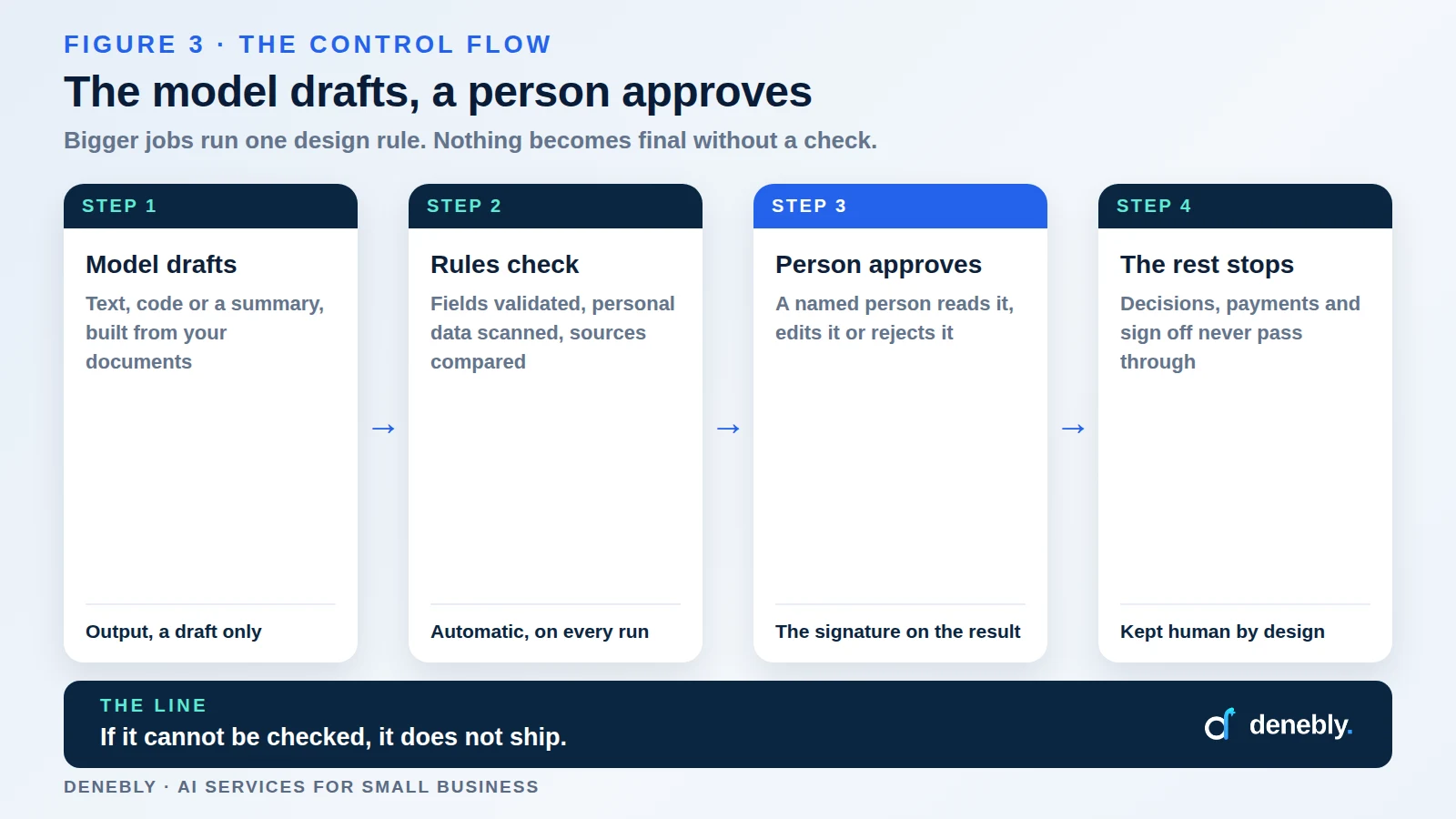
Bigger jobs follow one design rule, the model generates and a system or a person checks before anything becomes final. These three patterns are illustrative builds, not client case studies.
A shop assistant that answers from the live catalog
The assistant answers product questions from the retailer own catalog, pulled at the moment of the question, so prices and stock come from live data, not model memory. Checkout, refunds and order changes stay inside the store existing systems.
A voice assistant inside a connected vehicle
The model turns speech into a structured request, and the vehicle software decides which commands are safe to run. Braking, steering and every safety critical function stay outside the model reach, by design.
Billing drafts for a medical practice
The system drafts appeal letters for denied claims and suggests billing codes from clinical notes. Certified coders review every suggestion before a claim leaves the building, so accountability stays with qualified staff.
Generative AI or traditional AI, which one fits the task
Some jobs are not tasks for generative AI at all. Generative AI creates content. Traditional AI sorts, scores and forecasts, and matching the method to the output saves the budget the wrong match burns.
| Task need | Generative AI | Traditional AI |
|---|---|---|
| Main output | New text, images, code or audio | A label, a score, a forecast or an alert |
| Typical work | Drafting, summarizing, translating, chat | Fraud flags, demand forecasts, spam filtering |
| Best data | Language, documents and images | Structured tables and numbers |
| How it fails | Fluent content that is wrong | A wrong label or prediction |
| How you check | A person reads and edits | Accuracy measures and threshold tests |
Many sound products run both halves, each with its own checks, because generative output has no answer key and needs review or a rubric, not an accuracy score.
Tasks generative AI should never own
Seven kinds of task fail the three questions. Keep them with qualified people, and let the model draft only the paperwork around a decision a person owns.
- Medical diagnosis. A plausible wrong answer can harm a patient before anyone spots it.
- Legal advice. Models have invented case citations, and the client pays for acting on them.
- Investment decisions. The call needs verified current data and an accountable owner.
- Hiring decisions. Screening by model risks bias against protected groups and legal exposure.
- Safety critical engineering. Structural and vehicle control work needs tested methods, not predicted text.
- Compliance sign off. A model drafts the summary. A qualified person confirms every obligation.
- Exact arithmetic. Language models predict likely text rather than calculate, so totals belong in a spreadsheet.
Private data draws the same line across all tasks for generative AI. In 2023 Samsung restricted staff use of generative AI tools after employees uploaded internal source code to one.
The risks of the wrong task, and the four layers that hold output
Six risks repeat when tasks for generative AI run without the checks.
- Invented facts. The model states false figures and sources with full confidence, which NIST names confabulation.
- Bias. Output repeats training data skews, hardest near hiring, lending and pricing.
- Privacy leaks. Prompts can be stored under the tool terms, and pasted data does not come back.
- Copyright disputes. Output can sit close to protected work, and ownership of generated content is unsettled.
- Security gaps. Prompt injection can turn an assistant into a doorway for attackers.
- Overdependence. A team that stops checking loses the skill of spotting the error when it matters. NIST AI 600-1, from July 2024, names that habit automation bias.
Control works in four layers. Instructions set the role, tone and refusal rules. Structured output forces fields a program can validate. Automated filters scan for personal data and compare answers against sources. Human approval signs off anything that reaches a customer.
Ethics a small team cannot skip
Beyond the operational risks sit six duties a team owes its customers. Transparency means telling customers when they read generated text or talk to a bot, and labelling synthetic media. Consent means personal data enters a tool only on a lawful basis. Fairness means testing output for bias before it goes near hiring or pricing.
Intellectual property means respecting creators, including prompts that copy a living artist style. Accountability means a named owner for every AI assisted output. Environmental cost means heavy generation is reserved for work that justifies the energy. The UNESCO Recommendation on the Ethics of Artificial Intelligence, adopted by all 193 member states in November 2021, frames the same duties around human rights and transparency.
Synthetic media shows why the duties bite. Generative adversarial networks, from Goodfellow and colleagues in 2014, taught machines to fake realistic media, and diffusion models pushed realism further after 2020. Under Article 50 of the EU AI Act, deepfakes need disclosure from 2 August 2026, so a labelled marketing image passes and an unlabelled fake of a real person fails.
Six working habits that keep output accurate
Teams that get steady value from tasks for generative AI share six habits.
- Write specific prompts. Give the role, the context, the audience, the format and one example of a good result.
- Supply the source material. Your own documents in the prompt cut the invention rate more than any wording trick.
- Check every factual claim. Names, numbers and dates get verified against a trusted source before use.
- Protect sensitive data. Approved tools with clear data terms, and personal data stays out of public chat windows.
- Save the prompts that work. A saved prompt turns one person experiment into a team workflow others can audit.
When a passing task stops being a chat task
A task that passes the test and then runs forty times a week changes shape. The bottleneck becomes the connections and the checking queue. Prompts live in one person chat history, source documents drift out of date, and nobody owns the failures.
That is the point where a managed build takes over. The model sits inside your systems, grounded in your documents, with approval steps and logs. Denebly builds these systems for small teams through its generative AI services, and our guide to what are managed ai services explains who owns the watching after launch.
The answer to which tasks are appropriate for using generative ai does not change at that point. The task was always fitting. Only the plumbing grows up around it. Start through our contact page with your scored task list.
Frequently asked questions
What would be an appropriate task for using generative ai
Any task where the model drafts, summarizes or brainstorms and a person checks the result quickly, with a mistake cheap to fix. Document summaries, content drafts and data formatting pass. Diagnosis, legal advice, investment calls and hiring decisions do not.
Which task counts as a generative AI task
A task where the system produces new content, an email, a summary, an image or code. Sorting, scoring and forecasting return a label or a number, and those belong to traditional AI.
Is generative AI good for making decisions
No. It should not make final decisions in health, law, finance or hiring. It can prepare the options, the summary and the draft that help a qualified person decide faster.
How do I know if a task is safe to give to generative AI
Score it on the five checks in this guide, content, check speed, mistake cost, source material and data safety. Eight or more, hand it over. Under five, the task stays with a person.
What is a best practice when using generative AI
Human review of every output before it leaves the team. Supply the source documents, write a specific prompt, and verify each name, number and date before anything ships.
What are functional tasks
The routine work that keeps a business running, processing invoices, answering support tickets, updating records. Generative AI fits the functional tasks built on drafting and summarizing. Fixed step work belongs to rule based automation instead.
Sources
- Noy and Zhang, Science, 2023. Experimental evidence on ChatGPT and professional writing tasks.
- Brynjolfsson, Li and Raymond, Generative AI at Work, National Bureau of Economic Research working paper. Support agent productivity.
- Dell’Acqua and colleagues, Harvard Business School working paper, 2023. The 758 consultant field experiment.
- Peng and colleagues, 2023. The GitHub Copilot controlled experiment on developer speed.
- National Institute of Standards and Technology, NIST AI 600-1, Generative AI Profile, July 2024.
- Lewis and colleagues, 2020. Retrieval augmented generation for knowledge intensive tasks.
- UNESCO, Recommendation on the Ethics of Artificial Intelligence, adopted November 2021.
- European Union, EU AI Act, Article 50. Transparency duties for synthetic media.
- Studies and documents checked 20 November 2026.

WRITTEN BY
Arslan Mushtaq
Founder, Denebly
Arslan founded Denebly in 2018 and leads its AI development work for startups and mid-size businesses, across AI chatbots, agentic workflows, RAG systems, machine learning and automation. Denebly has delivered 100+ projects from Dallas, Texas.
Ready to Solve Your Business Problems With AI?
Tell us what you are trying to build, automate or fix. You will get an honest assessment within one business day, not a sales pitch.